In June 2002, Joel Spolsky published a short piece of microeconomics that explains a surprising amount of this month's AI news. Strategy Letter V is about complements: products people usually buy or use together. Gas and cars. Flights to Miami and hotel rooms in Miami. When a complement gets cheaper, demand for the focal product generally rises. A differentiated supplier may capture some of that increased value.
Spolsky compressed the strategy into one line: "Smart companies try to commoditize their products' complements."
His reading of the early PC market is worth revisiting. IBM built the PC from off-the-shelf parts and documented its interfaces so third-party companies could build memory boards, drives, graphics cards, and printers. Cheap add-ins made PCs more useful. Microsoft licensed DOS to IBM nonexclusively, and IBM sold it as PC DOS. Microsoft kept the right to license MS-DOS to compatible-PC makers, so cheap hardware increased demand for the operating system. IBM eventually sold its PC business to Lenovo. Microsoft remains at the center of the PC ecosystem.
Google later ran a cleaner version. Android's primary economic role was not a per-device operating-system license. Google made the Android Open Source Project (AOSP) freely available, expanded the device ecosystem, and then monetized Search, Play, and other proprietary services distributed through it. The operating system was the layer Google made cheap so the rest of the business could grow.
Values may be sincere, but they do not explain the timing on their own. Incentives do. Several companies are now running versions of this play on one another at once. Treat the open-weight debate as market strategy as well as a values argument, and it reads differently.
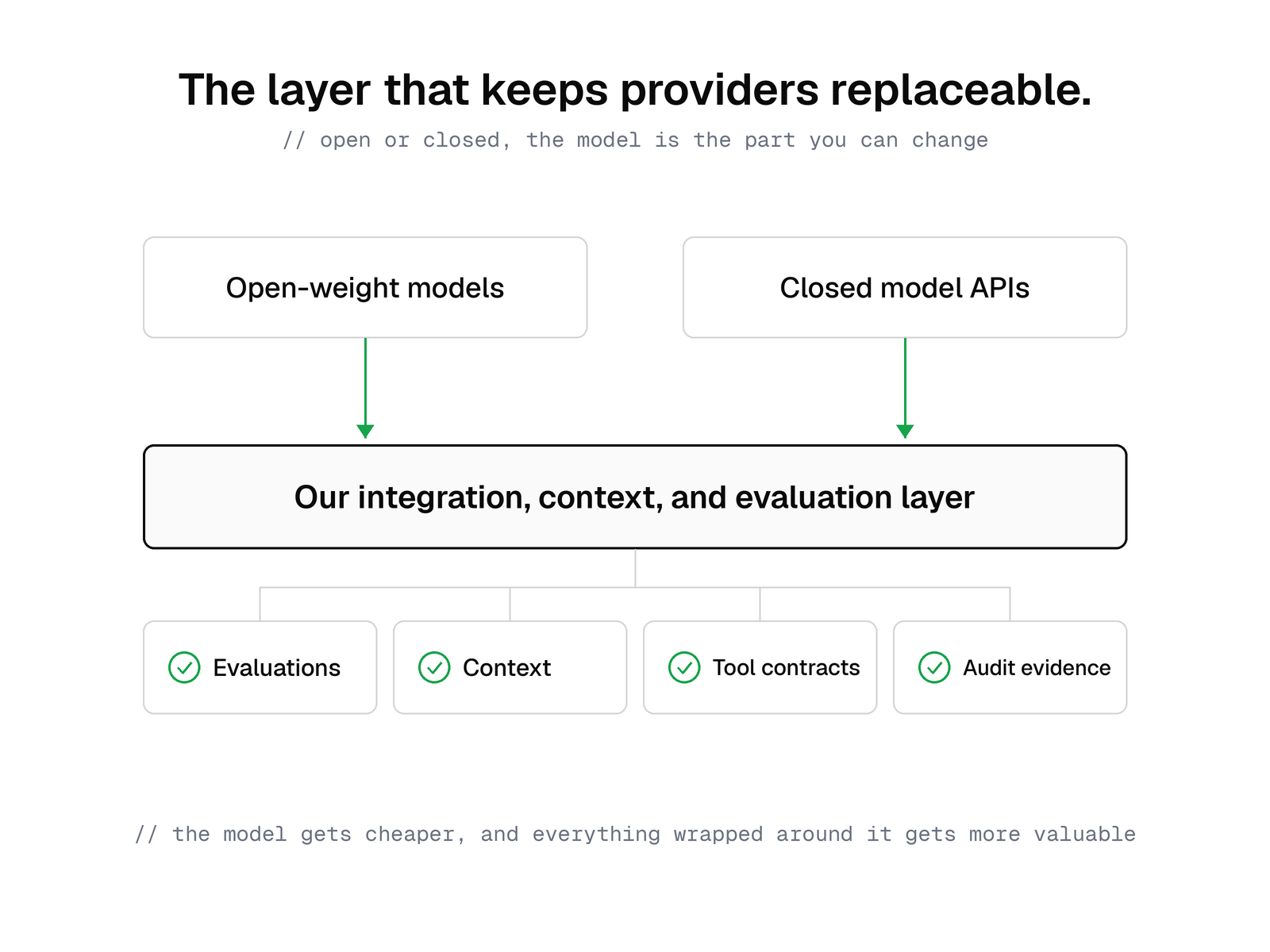
Open and closed releases move margin around the AI stack. The price of access keeps falling. The cost of trust holds, and that gap is the whole argument. For enterprise platform teams, the durable assets are the evaluations, context, tool contracts, and audit evidence that let us change models without starting over.
One definition before going further: open-weight means that the trained parameters are available to download. It does not mean the full training system is open, the license is unrestricted, or the model must be self-hosted. The same artifact can run through a managed endpoint, dedicated hosting, a customer-operated cluster, or a local device. Those are separate architectural and economic choices, and I worked through the local end of that spectrum in The Frontier on Your Laptop.
What each player is trying to make cheap
I sit on the buyer's side of these contracts, so I watch model choices turn into cloud commitments, security controls, capacity plans, and exit costs. Six players are running versions of this play on each other right now.
| Player | The play | The evidence |
|---|---|---|
| Hyperscalers (AWS, Microsoft) | Make accelerators and model access cheaper. The durable prize is platform consumption on their own bill and control plane. | Microsoft introduced Maia 200 in January 2026 on TSMC's 3nm process, claiming 30% better performance per dollar than its current fleet. AWS made Trainium3 UltraServers generally available in December 2025. Anthropic committed more than $100 billion to AWS over 10 years for up to five gigawatts, then committed $30 billion to Azure compute while Nvidia and Microsoft agreed to invest up to $10 billion and $5 billion in the company. |
| Nvidia | Make models and cloud capacity plentiful and contestable, so aggregate demand grows faster than serving efficiency cuts compute per task. | Nemotron 3 Ultra ships 550 billion total parameters, 55 billion active, under the permissive OpenMDW-1.1 license. A revenue-sharing and credit-support model for participating AI clouds followed in July. In March it invested $2 billion in Marvell and brought Marvell's custom silicon and networking into NVLink Fusion. |
| Meta | Make locally deployable intelligence cheap. Its economics still sit in apps, devices, advertising, and developer reach rather than token sales. | Muse Spark arrived closed on April 8, went metered through the Meta Model API on July 9, and 1.2 stayed closed on August 5. Five days later Meta released Muse Glimmer, 30 billion parameters under Apache 2.0, tuned for always-on local agents. Zuckerberg committed to opening Muse Spark 1.2 the same day, repeated in research on August 20. |
| Chinese labs (DeepSeek, Qwen, Moonshot, Z.ai, MiniMax) | Substitute for American model APIs outright, which pulls demand toward the clouds, devices, and apps their platform owners run. | Licenses run from MIT to Apache 2.0 to MiniMax M2.7's non-commercial terms, which require written authorization. Wing Venture Capital estimated Chinese-origin models at 56% to 61% of OpenRouter token volume in May 2026, four of the five most-used models, with Xiaomi's MiMo at roughly 21% and Meta below 1%. |
| Frontier labs (OpenAI, Anthropic) | Nothing yet. They are annexing the layer above the model instead: coding agents, applications, and workflow surfaces. | Menlo Ventures' December 2025 enterprise study put Anthropic at 40% of enterprise LLM API spend, OpenAI at 27%, and Google at 21%, with Anthropic's lead driven substantially by coding. |
| Stripe | Make the routing layer neutral and cheap, then meter what flows through it. | Agreed to acquire OpenRouter on August 19. |
Three things sit underneath that table. Equity investments, compute purchases, and capacity agreements are different instruments, and collapsing them into one headline number flatters the story. Together they still fit one portfolio strategy: secure scarce model supply and differentiated demand while improving infrastructure cost and supplier leverage. Satya Nadella put it plainly. "We're increasingly going to be customers of each other."
The second is the move I keep coming back to, because it undercuts the substitution story. AWS is designing Trainium4 to support NVLink 6 and Nvidia's MGX rack architecture. AWS reduces its accelerator dependence while still using Nvidia's scale-up fabric and rack ecosystem. Nvidia's fiscal 2026 results report $215.9 billion in revenue at a 71.1% company-wide gross margin, down from 75.0% a year earlier with a $4.5 billion charge on H20 inventory among the causes. Neither figure proves where the surplus settles. Both are consistent with real pricing power at the infrastructure layer today.
Reducing dependence on a supplier is hard when your substitute still uses roads the supplier built.
The third is where the complement frame only half applies. Chinese open-weight models are substitutes for American APIs, not complements, and their effect is downward price pressure on every workload they can serve. The frame explains why platform owners such as Alibaba and Xiaomi amplify that pressure, since accessible models pull demand toward cloud services, devices, and downstream applications. It does not explain every independent lab's motive. The OpenRouter figure needs the same care, because it counts tokens routed through one marketplace rather than global market share.
That marketplace just changed hands. Patrick Collison framed the Stripe deal around helping companies route requests intelligently and spend tokens efficiently. A payments company buying the neutral switching layer is the same play, one level up.
The asymmetry that decides this
Near the end of his letter, Spolsky made an observation that has aged well as a heuristic. Software can make hardware more substitutable by hiding differences behind an abstraction. Hardware has a harder time commoditizing software, because switching costs live in behavior, data, integrations, and learned habits.
Modern AI hardware complicates the clean version of that story. The top-level API may look thin. Underneath it, compilers, hand-tuned Triton and FlashAttention kernels, collective communication libraries, quantization formats (FP8, AWQ), memory topology, and serving-runtime optimizations stay tightly coupled to the silicon. That is one reason downloadable weights can still reinforce Nvidia's position.
Model access breaks the pattern in another way. A normalized gateway can make a first experiment look like a simple configuration change. Production substitution is harder. Tokenization, prompt formats, tool calling behavior, context limits, safety guardrails, latency distributions, rate limits, and serving topology can all change underneath the endpoint.
The cost of access to capable weights is falling faster than the work required to substitute them safely in production. The switching cost did not disappear. It moved into the evaluation suite that proves a model is good enough for your risk tolerance. It lives in the prompts and tool contracts your agents depend on. It lives in the retrieval and context layers that make a general model useful, and in the audit trail your regulators expect.
Changing a model identifier can be easy. Re-earning confidence is not.
That is the argument I made in Context Is a Platform Capability Now, arriving from a different direction. The model gets cheaper, and everything wrapped around it gets more valuable. The Kill Switch Was Always There reached the same place from a government order, where portability gets you out and verification gets you out safely.
The number that should slow everyone down
Here is the finding that complicates every clean narrative about open weights winning. Menlo's late-2025 study estimated that models it labels open source fell from 19% to 11% of enterprise LLM API spend. Those are primarily open-weight artifacts under varying permissive and community licenses. Menlo attributes much of the decline to Llama's stagnation, with no major release since Llama 4 in April 2025. Chinese open-source models account for roughly 1% of total enterprise LLM API usage in the same data. The study surveyed 495 U.S. enterprise AI decision-makers and estimated dollars from respondents' reported shares of production API workloads, weighted by application scale and triangulated with public financials where available.
That is relative share, not proof that absolute usage fell. It does not tell us that most enterprises tried self-hosting and rejected it. Menlo's evidence also ends in 2025, even though open-weight capability continued moving through 2026.
Set that beside the OpenRouter figure and you do not get a contradiction. You get two signals measured different ways. OpenRouter aggregates prompt and completion tokens processed through its own API, and its rankings do not establish a geographic population of buyers. Menlo estimates U.S. enterprise LLM API dollars from reported production workload shares. The channel, population, unit, and method all differ. A partial bridge exists. CNBC reported in July 2026 that Chinese-origin models accounted for 46% of U.S. enterprise token usage on OpenRouter, a figure that sits between the two.
The divergence is still useful. High routed token volume on OpenRouter does not automatically translate into enterprise procurement. Capability, support, indemnity, provenance, managed availability, data residency, security review, and a 2 a.m. escalation path all affect the decision.
The constraint is not simply capability or simply cost. It is whether the full operating model can clear the organization's bar. Anyone who has taken a self-managed model through security review has felt that gap firsthand.
The economics of the model layer changed faster than the operating model around it.
Your switching cost is somebody else's margin
Across these examples, companies are making complements cheaper, substituting for suppliers, or moving into stickier adjacent layers. The tactics differ, but each seeks more leverage over where margin accumulates.
From the enterprise buyer's chair, the true sovereign asset is our integration, context, and evaluation layer, not the model. Our workflows, proprietary data, evaluations, corrections, permissions, and controls turn a general model into a business system. That is the same asset I called the learning loop in Paying for Intelligence Twice, and it is the thing the Context Spine was always meant to hold. If those assets live behind one vendor's boundary, the cheap model becomes an expensive exit.
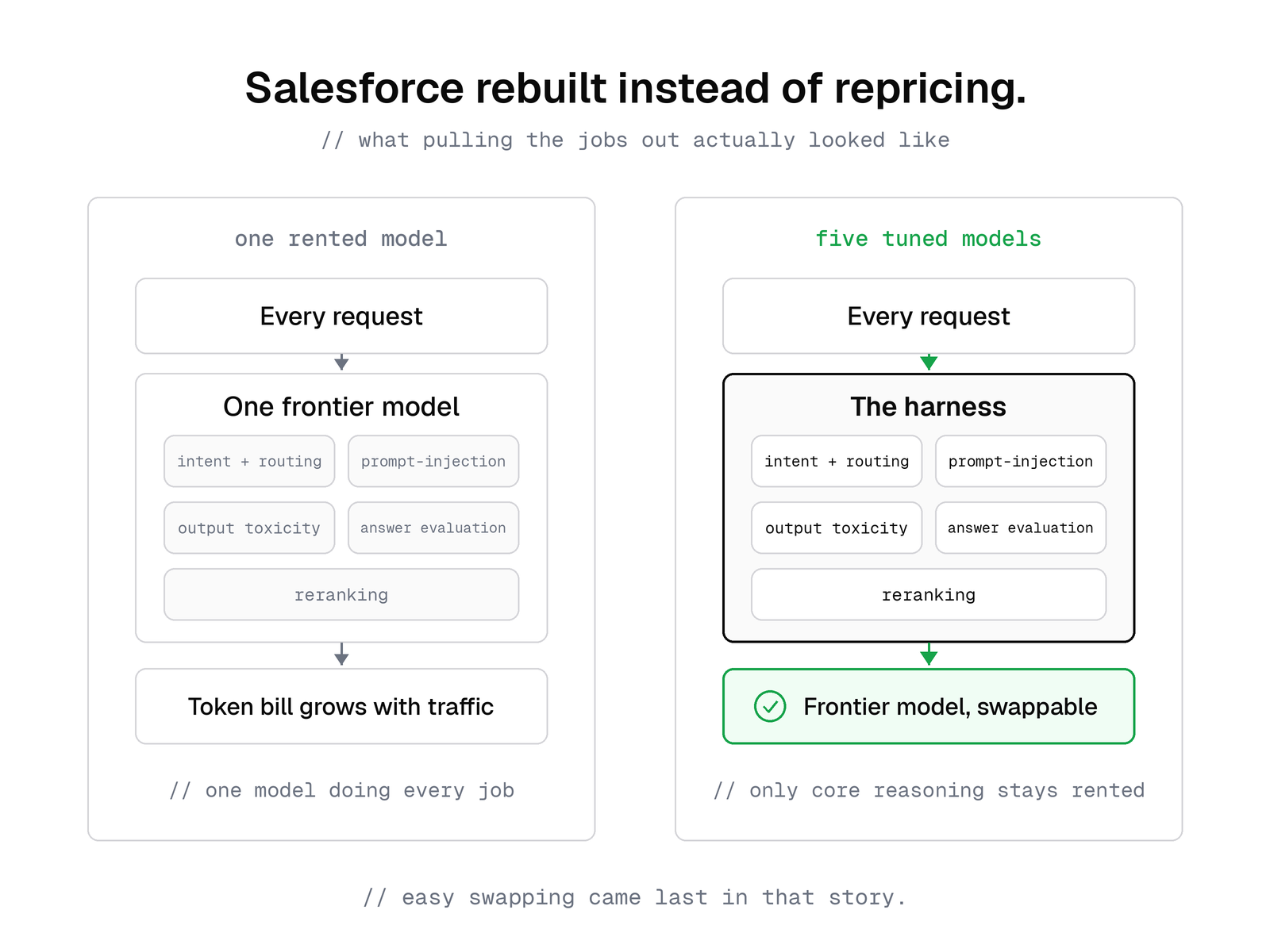
Salesforce wrote up the clearest version of this problem I have seen from a vendor. In a July 2026 post, the company described how Agentforce had run entirely on one rented model while its token bill grew with traffic. Salesforce then pulled out five narrower jobs: intent detection and routing, prompt-injection screening, output toxicity screening, answer evaluation, and reranking. It tuned a task-specific open-source model for each, using patterns from millions of jobs its harness had already processed. Two of those models, the classifier and the evaluator, are fine-tuned from OpenAI's gpt-oss-20b. The open weights one lab released are now displacing another lab's rented frontier calls.
It did not replace every frontier call. A frontier model still handles core multi-step reasoning, and the harness Salesforce built lets it and its customers swap that model freely. Easy swapping came last in that story. Salesforce could build toward it because it had recurring workload volume to amortize specialization, telemetry to find reusable seams, and a trust layer to deploy into. Portability was the output of that investment rather than a property of open weights. Its result shows that decomposition works under the right conditions, and those conditions are the expensive part.
Shared on-demand APIs usually turn capacity risk into a variable bill. Provisioned throughput and customer-operated clusters move more of that risk to the buyer through hourly reservations, minimums, or fixed or stepwise capacity, though autoscaling and overage terms vary. On unit economics alone, those options win when sustained utilization amortizes idle and high-availability headroom and the organization can absorb upgrades, observability, safety work, and on-call ownership. Teams may still choose them for latency, residency, or control.
Compare cost per successful task over the real production distribution rather than price per million tokens. Include retries, failures, idle capacity, and the resources needed to hold the p95 latency SLO at design load.
I would not read Salesforce's result as an argument for operating every model yourself. I would not read Menlo's 11% as evidence that most enterprises tried the cheap option and rejected it either. I read both as an argument for keeping the exit affordable.
Five practical moves follow, each within a platform team's reach this quarter:
- Price the exit and the option. Measure engineer-weeks, dual-running, data egress, compliance recertification, replacement capacity, unused commitments, contract termination, and rollback. Run a representative model-switch drill instead of estimating from a diagram, then put the resulting number in front of your finance partner. An unpriced option loses every budget argument it enters.
- Treat evaluation assets as durable infrastructure. Keep a versioned task corpus, production traces, human labels, rubrics, and explicit acceptance thresholds. Run them in the delivery pipeline, and recalibrate model-based judges when the model changes.
- Route by evaluated workload class. Choose the least costly option that clears quality, safety, latency, residency, and reliability requirements. The answer may be deterministic software, a small managed model, a tuned open-weight model, or a frontier model. Add canaries, fallbacks, and rollback.
- Keep the context contract under enterprise control. Own the canonical sources, permissions, provenance, schemas, version history, and reconstruction path. Vendor-managed indexes and caches are fine when they are disposable, exportable, and rebuildable.
- Budget the full bill. Proprietary APIs still require integration, evaluations, and governance. Customer-operated open weights add capacity planning, serving operations, cloud or hardware cost, power where directly operated, patching, observability, disaster recovery, model refreshes, incident response, and the people who own all of it. Measure cost per accepted outcome under your target SLO.
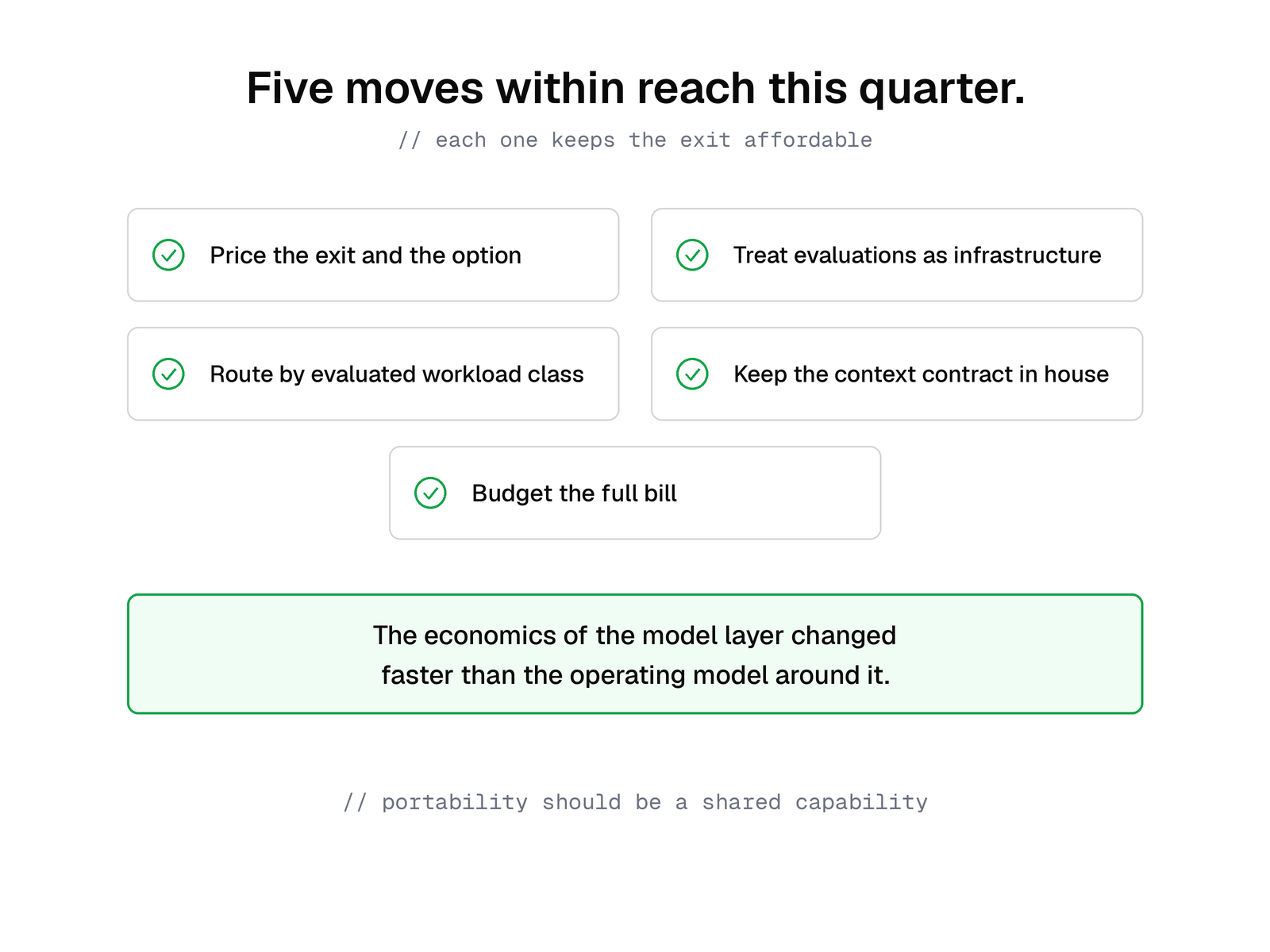
The platform team's job is to absorb this complexity once, so every product team does not have to become expert in model procurement, inference operations, and governance. Portability should be a shared capability rather than another burden handed to developers.
Where this argument could be wrong
The complement frame predicts incentives. It does not read minds, and I would rather name its limits than oversell it.
Motives here are genuinely mixed. Some open releases come from research culture, recruiting pressure, and a real belief that broad access makes systems safer. Meta's shifting distribution strategy looks tactical. Google and OpenAI have publicly framed Gemma and gpt-oss around access, research, and responsible deployment, and I take those framings at face value. Strategy and conviction can point the same way.
The stronger objection is that enterprise buyers may never value portability enough to pay its option cost. The simplicity of one vendor, one contract, and one accountable party may keep winning even if open weights hold capability parity. That outcome could mean switching risk matters less than I think. It could mean managed accountability is worth the lock-in, or that closed-model capability stays sufficiently differentiated. I do not think leaders should fund portability on faith. Price it, then decide.
The evidence that would change my mind is specific. Show me several large, regulated enterprises that repeatedly move production agent workloads across model families in weeks. Assume no prior investment in vendor-neutral evaluations, context contracts, or audit paths. Quality, safety, latency, unit economics, and rollback all hold. That would materially weaken my claim that portability must be built as a strategic platform capability.
I have not seen that pattern yet. I would like to.
Platform leaders cannot control which layers vendors choose to make cheap. We can control whether our evaluations, context, and audit trail keep those vendors replaceable. Make that choice deliberately, before someone else makes it and sends the invoice.