The late Bill Coleman, co-founder and first CEO of BEA Systems, once told me a story I have not been able to shake. We were a large WebLogic customer, which is how I ended up with an afternoon of his time. Coleman had seen the spreadsheet revolution from the inside. Before BEA, he led product development at VisiCorp during the development of VisiCalc, the first spreadsheet for personal computers.
He told me that before spreadsheets, finalizing the quarterly earnings report at a public company could take six weeks. Every change meant recalculating a wall of numbers by hand, so the team spent most of the reporting cycle doing arithmetic. Then VisiCalc and its descendants automated most of the manual recalculation. The reporting cycle should have collapsed to days.
It still took six weeks.
The time did not disappear. It moved. The team ran more scenarios, stress-tested more assumptions, and asked better questions of the same numbers. Spreadsheets changed everything about the work and nothing about the calendar.
AI is running the same experiment on software development right now. The pitch for every AI tool is saved hours, and after a couple of years of daily agentic coding, I know the hours can be real. They do not appear on every task or for every engineer, but they show up often enough to matter. The question I care about is what happens to them. When AI hands you back an hour, where does it go?
The question is no longer only whether AI can create capacity. The bottleneck is whether leaders can express what that capacity is for, then build a system that keeps it from disappearing.
The four destinations
Across 150 years of productivity history, I keep seeing the saved hour land in four places. The categories overlap, and most organizations will fund all four. The leadership question is not whether the dividend gets spent. It is whether anyone chooses the mix.
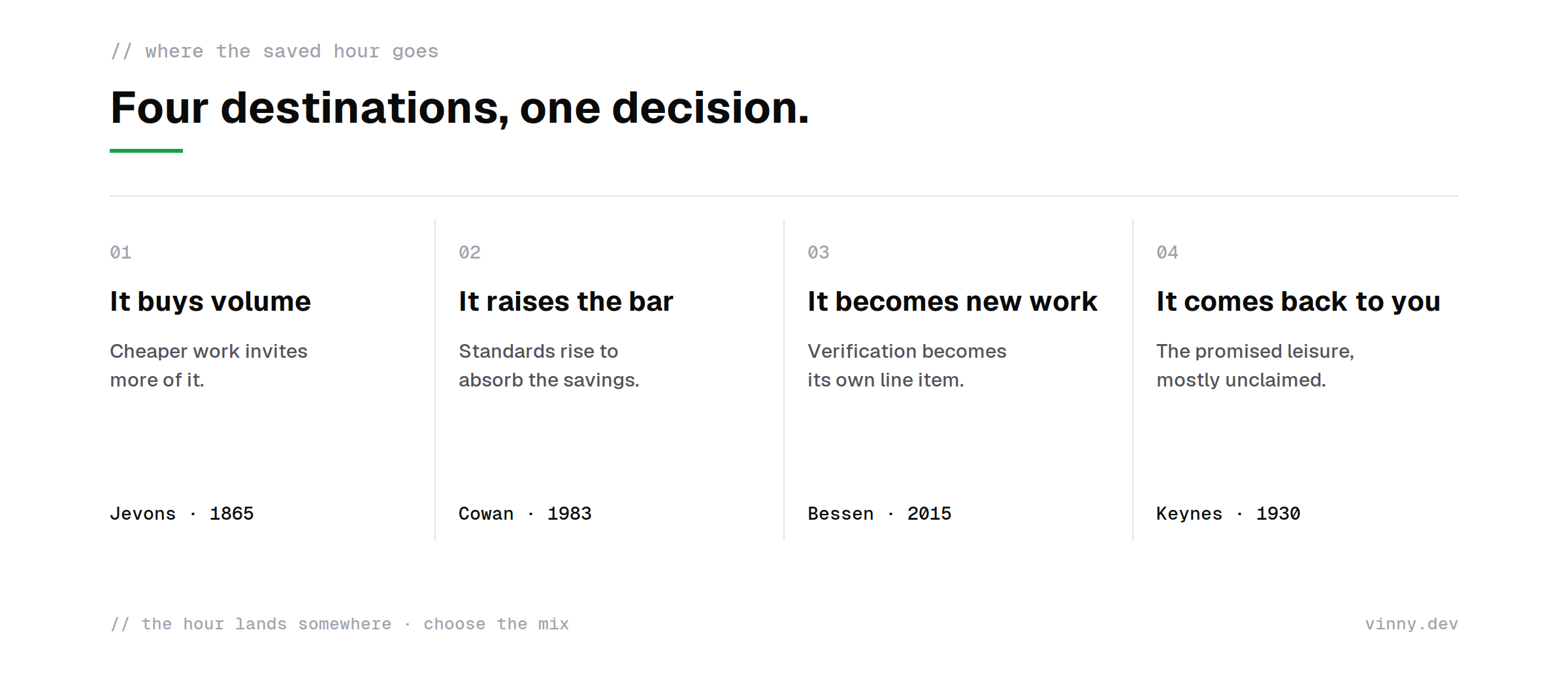
It buys volume. William Stanley Jevons observed in The Coal Question in 1865 that more efficient steam engines did not reduce Britain's coal consumption. They made steam power cheaper and expanded its use. Efficiency lowers the cost of an activity, and demand often grows to consume the savings.
Spreadsheets ran the same play on analysis. Planet Money reported that between 1980 and 2015, the number of bookkeeping and accounting clerk jobs in the United States fell by roughly 400,000 while accountant jobs grew by about 600,000. Analysis got cheaper, and clients who could suddenly afford the what-if game bought far more of it. Steven Levy saw the deeper shift in his 1984 essay, "A Spreadsheet Way of Knowledge". The spreadsheet did not merely accelerate calculation. It made modeling a way of working.
Code is the cheap resource now. When code gets cheaper, we attempt more software, more variations, more automation, and more work that never cleared the old business case.
It raises the bar. Ruth Schwartz Cowan's More Work for Mother traced how household technologies did not simply return leisure. Work moved, expectations changed, and standards rose to absorb part of the savings. Software inflates the definition of done the same way, with more tests, more polish, stronger documentation, and more edge cases handled inside the same sprint. The six-week reporting cycle lives here too. The deadline stays fixed while the expected quality climbs.
It becomes new work. The economist James Bessen studied what ATMs did to bank tellers. For several decades, tellers per branch fell, cheaper branches multiplied, and total teller employment grew while the job shifted from counting cash toward customer relationships. The machine removed one task and helped create demand for another.
AI's version of the new work is verification. Faster generation can create a larger review queue unless evaluation capacity grows with it. Prompting, waiting, reading, testing, correcting, and coordinating do not vanish just because typing gets fast. I made this argument in the book and in The AI Operating Ledger: evaluation capacity is a real constraint that deserves its own budget line. We saved time writing and spent it reading.
It comes back to you. This is the destination John Maynard Keynes promised in 1930. In "Economic Possibilities for Our Grandchildren", he imagined that productivity could eventually support a 15-hour workweek. The productivity arrived, but the leisure did not arrive in anything like the form he expected, because we took much of a century's gains as output and consumption instead of time.
There are signs that workers would like to claim this destination. A Zoom-sponsored Morning Consult survey found that 76% of AI users reported saving at least 30 minutes a day, and 73% said they would use saved time for a dedicated lunch break. That measures intention, not where the time landed. Still, I hope it holds. History is not on its side.
The law that decides for you
If nobody chooses among those four destinations, the choice gets made anyway. C. Northcote Parkinson named the mechanism in 1955: "Work expands so as to fill the time available for its completion." He wrote it as satire about the British Civil Service, and it reads today like a systems requirement.
Oliver Burkeman sharpened the same point in Four Thousand Weeks with what he calls the efficiency trap. Getting faster at email does not empty your inbox. It teaches the world that you reply quickly, so the world sends you more email. Because the demands on our attention are effectively infinite, efficiency alone cannot produce free time. The saved hour gets reabsorbed before anyone notices it existed.
The reabsorption is already visible. In a before-and-after analysis of 10,584 AI users, ActivTrak found that time spent across every measured work category increased after adoption. Email rose 104%, chat and messaging rose 145%, business-management-tool use rose 94%, and daily focus time declined 9%. The study is observational, so it does not prove that AI caused every change. It does show that adoption did not automatically produce visible slack.
An eight-month UC Berkeley Haas ethnography at one 200-person technology company found a similar pattern. Through workplace observation and more than 40 interviews, researchers saw employees broaden the scope of their jobs, insert AI work into moments that used to be pauses, and keep multiple workstreams or agents alive at once. The setting was narrow, but the behavior is recognizable. The tool made more work feel possible, so more work became normal.
David Brooks gives the allocation problem a useful name in "The People Who Will Thrive in the AI Age": "When intelligence is plentiful, volition is valuable." The tools create options. Volition, or your power to choose, decide, and take action, decides which options deserve the hour.
None of this makes reinvestment the enemy. The spreadsheet story is the happy version, where the same six weeks bought better answers and the deeper analysis was worth every reinvested minute. The trap is unexamined reinvestment, where Jevons buys volume, Parkinson fills the calendar, and the bar drifts upward without anyone deciding it should.
Cal Newport's Slow Productivity makes the case for one deliberate allocation, doing fewer things at a natural pace with an obsession over quality. Brooks emphasizes another, spending the dividend on effortful work that builds your own capability rather than using AI to avoid thinking. They emphasize different uses of the hour, and they agree it will not go anywhere good by default.
My own audit
I ran this experiment on myself before I had a name for it. AI coding tools have been part of my daily work for several years now, and the time dividend is real. Mine went into more shipped apps, more personal projects completed, and new apps built because the hours got cheap. It went into a book I might not otherwise have finished. It also went into deeper work on the job I already had, though not fewer hours.
What the dividend did not buy was a hammock at the beach for me.
That is Jevons operating on a small scale, and I do not regret those choices. I am also not sure I made all of them as choices. The demand was sitting right there, the hour got cheap, and the hour disappeared into the demand. Reflection never got a line item.
I wrote recently that the productivity ledger misses what used to happen inside the saved hour, including the practice and correction that produce judgment. This essay asks the next question: who gets to allocate the hour itself?
The dividend is net, not gross
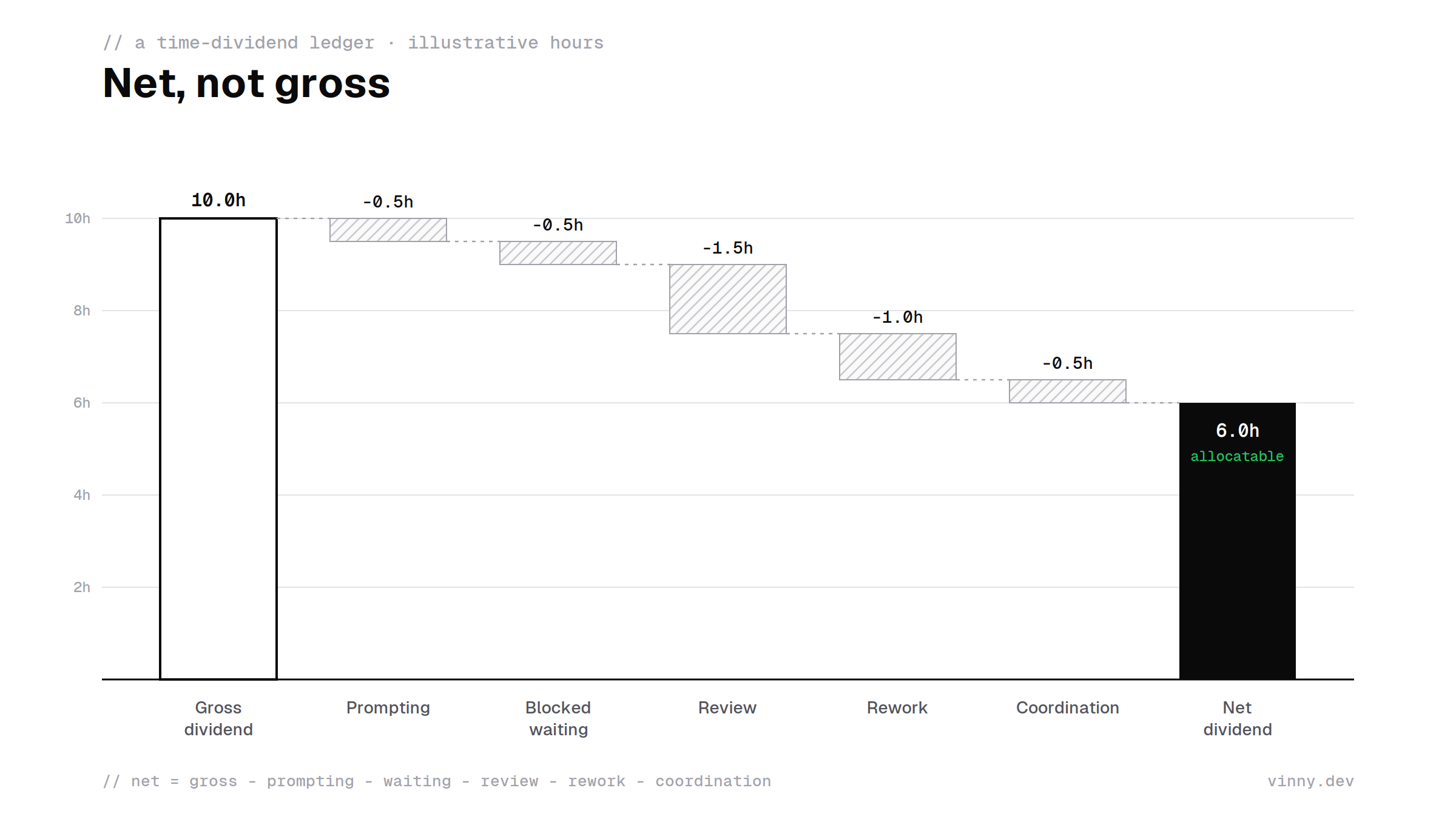
Before allocation comes accounting. The hour an agent removes from typing is a gross dividend. Prompting, waiting that blocks other work, review, correction, rework, and coordination are claims against it. Only what remains is allocatable capacity.
A team that celebrates gross savings while hiding review debt is counting the same hour twice.
That distinction helps reconcile some of the conflicting evidence on AI productivity. In METR's early-2025 randomized trial, 16 experienced open-source developers completed 246 real tasks in repositories they knew well. With AI available, they took 19% longer, even though they believed AI had made them 20% faster. The study does not show that AI slows most developers or most software work. It shows how easily interaction and verification overhead can disappear from our perception of time.
METR's late-2025 follow-up pointed toward speedup in its raw estimates, but the researchers concluded that selection effects and concurrent agent use made the size of that speedup unreliable. Developers who valued AI most were increasingly unwilling to join a study that might require them to work without it. Agentic work also made human time harder to count because people could switch tasks while an agent ran.
That reads to me as a warning about accounting by feeling, not a verdict on the tools.
The fair objection is that the dividend may be too small or uncertain to manage. In a Federal Reserve Bank of St. Louis survey, generative AI users reported saving an average of 5.4% of their work hours, about 2.2 hours in a 40-hour week. Self-reported savings are not the same as observed savings, but two hours is enough to disappear and enough to matter.
A simple time-dividend ledger makes the claims visible:
Net dividend = gross time removed - prompting - blocked waiting - review - rework - coordination.
| Work item | Gross time removed | AI overhead | Net dividend | Intended destination | Actual destination |
|---|---|---|---|---|---|
| Illustrative workflow | 10 hours | 4 hours | 6 hours | Modernization | Additional scope |
The arithmetic is intentionally boring, and that is the point. Measure the baseline, count the full cost of using AI, then name what happened to the difference. If the dividend turns out to be small, the discipline still holds. Measure first, then allocate.
Who gets to choose
The four destinations answer where the hour goes. They do not answer who gets to choose.
When an organization captures every saved minute as more output, that is not a neutral efficiency gain. It is a decision about how productivity gains are shared. Some of the dividend may rightly fund customer value, quality, modernization, evaluation, or learning. Some may need to return to the people creating it as recovery, slack, or a real lunch break.
The bargain becomes honest only when the allocation is explicit.
This matters because each destination benefits a different constituency. Volume may benefit customers and shareholders. Higher standards may reduce operational risk. New work may build organizational capability. Returned time may improve sustainability for the people doing the work. Leaders rarely get to choose only one, but they should be able to explain the mix and the trade-offs.
The worst answer is to call the entire dividend "productivity," absorb it into higher expectations, and pretend no allocation decision occurred.
Spend it on purpose
At work I lead an engineering organization of more than 250 people, and I have started treating the time dividend the way I treat money. I have written before about the AI operating ledger, the cost side and the payment side of buying intelligence. This is the time side of the same ledger, and it deserves the same discipline. Engineering leaders will chase a 4% cloud overage across three vendor calls and never ask where last quarter's saved hours went.
Volition is the scarce input now, and an allocation is volition written down, a specification for capacity before the calendar writes one for you.
An unallocated dividend gets spent anyway, with Jevons as your default portfolio manager and Parkinson running the calendar. If you want the saved hours to buy something specific, name it.
Hold delivery flat for a quarter and bank the surplus against the modernization or refactoring backlog. Fund evaluation capacity as its own line instead of taxing everyone's afternoons with review debt. Reserve part of the dividend for apprenticeship and deliberate practice so short-term speed does not consume long-term judgment. Protect slack that looks unproductive on a status report, because thinking often does. If what your team needs is the Keynes destination, actual recovered time, say that out loud. Nobody claims it by accident.
Then inspect the result. Did the time go where you intended? Did quality improve, did the backlog shrink, did capability grow, or did every estimate quietly tighten until the organization was working at the old pace with a higher output expectation?
The point is not to defend leisure from productivity or quality from volume. The point is to make the trade visible enough that a leader can own it.
So here is the assignment I am giving myself, and I would love company. For one week, every time an AI tool saves real time, write down the gross saving, the overhead required to earn it, and where the net dividend lands: volume, standards, new work, or returned time. Then compare the entries with what you would have chosen on purpose.
My guess is that the reporting cycle will still take six weeks.
This time I want that to be a decision.
Related reading
- The AI Operating Ledger
- Don't Automate the Apprenticeship Out of Engineering
- The Modernization Backlog Just Got Repriced
- The Bottleneck Is Never the Stack
Research notes
- W. Stanley Jevons, The Coal Question (1865)
- C. Northcote Parkinson, "Parkinson's Law," The Economist (1955)
- John Maynard Keynes, "Economic Possibilities for Our Grandchildren" (1930)
- Ruth Schwartz Cowan, More Work for Mother (1983)
- James Bessen, "Toil and Technology" (2015)
- Oliver Burkeman, Four Thousand Weeks (2021)
- Cal Newport, Slow Productivity (2024)
- Steven Levy, "A Spreadsheet Way of Knowledge" (1984)
- David Brooks, "The People Who Will Thrive in the AI Age" (2026)
- ActivTrak, "2026 State of the Workplace" (2026)
- UC Berkeley Haas, "Does AI Actually Free Up Workers' Time?" (2026)
- Zoom and Morning Consult, "Take Back Lunch" (2026)
- Planet Money, "Episode 606: Spreadsheets!" (2015)
- Federal Reserve Bank of St. Louis, "The Impact of Generative AI on Work Productivity" (2025)
- METR, "Measuring the Impact of Early-2025 AI on Experienced Open-Source Developer Productivity" (2025)
- METR, "We Are Changing Our Developer Productivity Experiment Design" (2026)