Picture two data purge requests landing in a compliance queue on the same afternoon. Both flag a user profile for deletion under the standard privacy policy. An AI compliance agent reviews the criteria it was given: account age, inactivity period, and privacy tags. Both records pass. Both get approved for a hard delete.
An engineering leader stops the second one before the deletion runs.
To the automated system, the profiles were identical, two inactive records slated for routine cleanup. To the human, they could not have been more different. The first belonged to an ordinary consumer account. The second belonged to a person under an active legal hold. The hold lived in another system, owned by another department. Deleting the first record satisfies a privacy mandate. Deleting the second destroys evidence a regulator expects the company to preserve.
Every criterion was valid; the set of criteria was incomplete. The catch came from a person who understood the case because they had sat in the meetings. They knew which of the company's obligations had not yet been written down anywhere a machine could read them.
The fix took a week. Legal-hold status is now one of the criteria, and the agent will check for it every time. Hold that fix in mind, because it is the whole story of this essay.
I've argued for a while that AI is not changing whether organizations need people. It is changing where people create value.
AI will reduce the amount of human labor required for many kinds of work. That upheaval is real. But it is not eliminating the need for people; it is concentrating their value where rules are incomplete, consequences are uneven, and context still matters.
In The Bottleneck Is Never the Stack, I argued that software delivery is no longer constrained by infrastructure or even engineering talent. The constraint has moved upstream, toward clarity of intent. This is the human side of that same story.
Every major technology wave changes what becomes scarce. Cloud made infrastructure more abundant. Platforms made deployment easier. AI is now doing the same thing for knowledge work. Each generation of capable models continues to lower the cost of generating code, writing documents, analyzing data, and exploring ideas. Execution is becoming abundant, and when execution becomes cheap, competitive advantage moves somewhere else.
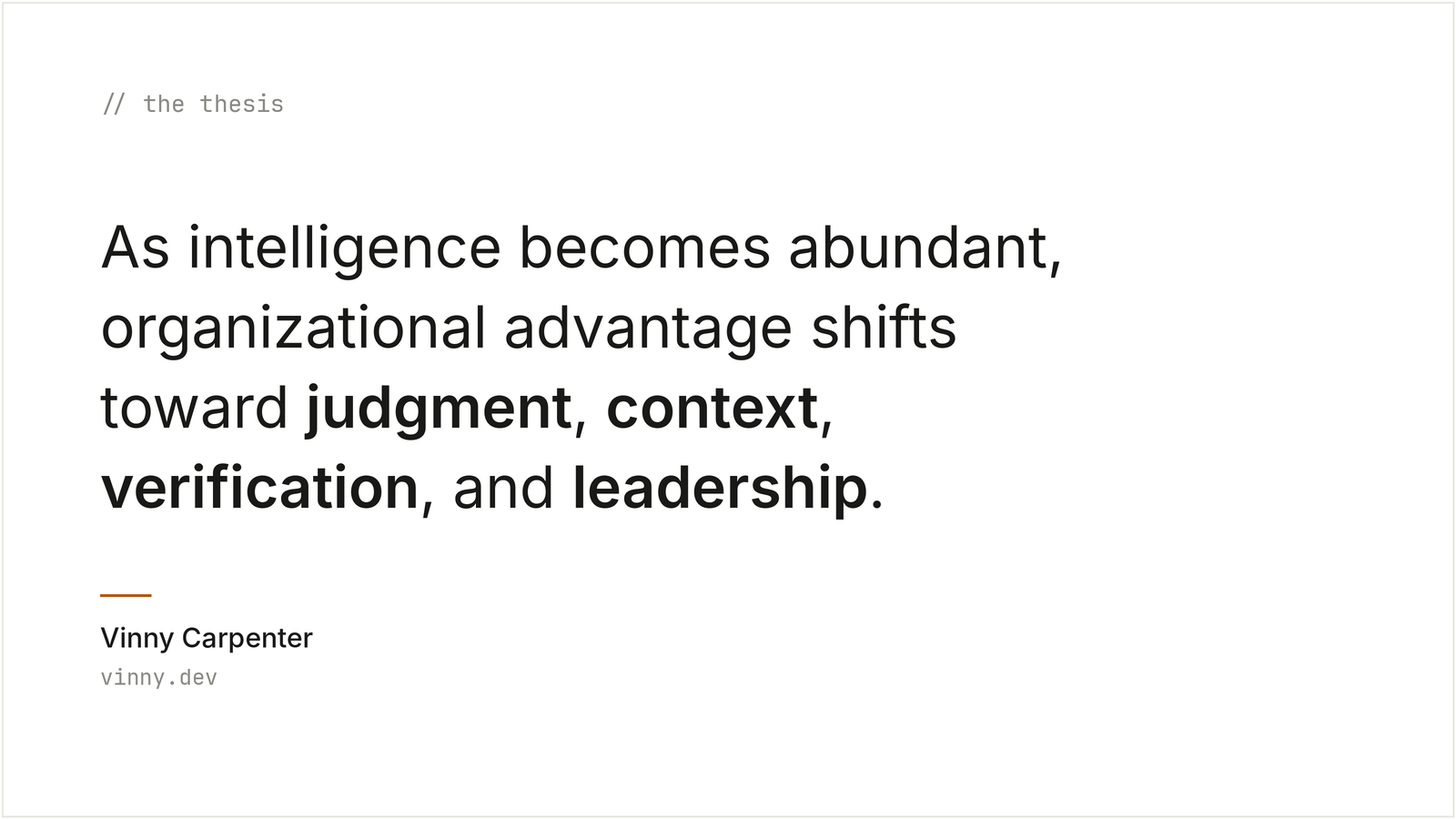
Judgment is not instinct dressed up as experience; it is the ability to combine context, evidence, consequences, and accountability when the rules are incomplete.
That idea explains why AI is both enormously destabilizing and surprisingly human. It also explains why I've become convinced that intelligence itself is becoming infrastructure. Access to capable models will become table stakes. Developers, analysts, designers, architects, and product managers will increasingly rely on them. As access to capable machine intelligence broadens, the differentiator becomes knowing what deserves it.
Models can reason, but organizations are built on decades of accumulated context that no model completely possesses. Competitive advantage rarely lives inside a single document or vector database. It lives in relationships, institutional memory, cultural norms, technical debt, customer history, unwritten assumptions, and thousands of decisions that shaped the company long before today's models existed. That context is difficult to copy because it was earned, not generated.
AI is remarkably good at answering questions. The harder problem is deciding which question matters. Organizations do not usually fail because they lack answers. They fail because they optimize yesterday's problem, automate the wrong workflow, or mistake a symptom for the actual constraint. That is a leadership problem, not a model problem.
This is also why context becomes strategic. In several of my essays, starting with The Agentic SDLC, I've described the importance of a Context Spine. That spine is the accumulated understanding of customers, systems, history, incentives, failures, and tradeoffs that lets an organization make consistently better decisions. Models possess enormous amounts of public knowledge. Organizations win because they possess private context, and AI makes that context more valuable, not less.
The same pattern appears in software delivery. In Everyone Knows You Never Rewrite, I argued that AI dramatically lowers the cost of iteration. Rewriting code, exploring alternatives, and trying new approaches become inexpensive. That amplifies engineering judgment instead of eliminating it, because when generating solutions costs almost nothing, choosing between them becomes the scarce skill.
That is also the economic argument behind Paying for Intelligence Twice: as intelligence becomes commoditized, proprietary context and institutional learning become the assets worth protecting. The value does not disappear; it moves.
The same is true for leadership, starting with relationships. The most important work inside large organizations has never been purely technical. It depends on trust, credibility, influence, and the ability to align people with different incentives. AI can summarize the meeting, but it cannot inherit 20 years of earned trust.
Pattern recognition becomes more valuable as well. I do not mean statistical pattern recognition, which models already perform extraordinarily well. I mean organizational pattern recognition. Experienced leaders recognize failure modes before dashboards expose them. They understand which proposals have failed before, why they failed, and which invisible constraints still exist. They know when two situations that appear identical are fundamentally different. The purge queue is that story at machine speed. That is judgment.
Humans are not valuable because they are infallible; the leader in the purge queue has missed things too. The advantage comes from accountable people working inside systems that expose uncertainty, require verification, and turn newly discovered context into durable controls. The goal is not heroic intervention but an organization that learns. That is the argument behind Trust the Gate, Not the Actor: reliable systems should not depend on any one person or model getting everything right.
Perhaps the most valuable human skill of all is asking the question nobody else thought to ask. Models can challenge a frame, but they do not own the consequences of choosing one. Leaders do. I made the case for human-led framing at length in The Frame Is the Bottleneck, and the distinction grows more valuable every year.
The obvious objection is mine
If you have been reading these essays, you can see the problem. I keep telling organizations to write their context down, version it, and feed it to agents. The Context Spine exists to make private context machine-readable. The gates in my own delivery pipeline exist to encode judgment so it runs at full sharpness even when I am tired. If that program succeeds, the uniquely human share should shrink with every commit.
It does shrink, and that is the point. We can add legal-hold status to the purge criteria, and we should. But encoding is itself an act of judgment, all the way down. Someone decided that criterion was missing. Someone will notice when the next one is missing, because an organization creates new obligations, exceptions, and tacit understandings faster than anyone writes them down. Someone also has to know which accumulated context is an asset and which is baggage, because context expires too. The moat is not the context itself but the ongoing act of curating it.
Here is what would change my mind. If models begin absorbing organizational context faster than organizations generate it, the value really is migrating into the spine. The same is true if thin-context companies run by agents start consistently beating context-rich incumbents. Either way, I will have overstated the human share, and this essay deserves a correction. I am watching for both. I have not seen either.
The more I write about AI, the more I arrive at the same conclusion from different directions. The bottleneck is not the model, the framework, or the programming language. It is not even intelligence itself. The scarce resource is judgment.
The organizations that outperform over the next decade will not simply have the best AI. They will have the people who know what deserves attention, what deserves skepticism, what deserves verification, and what deserves to be built.
The execution surrounding those choices will become increasingly abundant. The consequences will not.