the book · second edition · available now
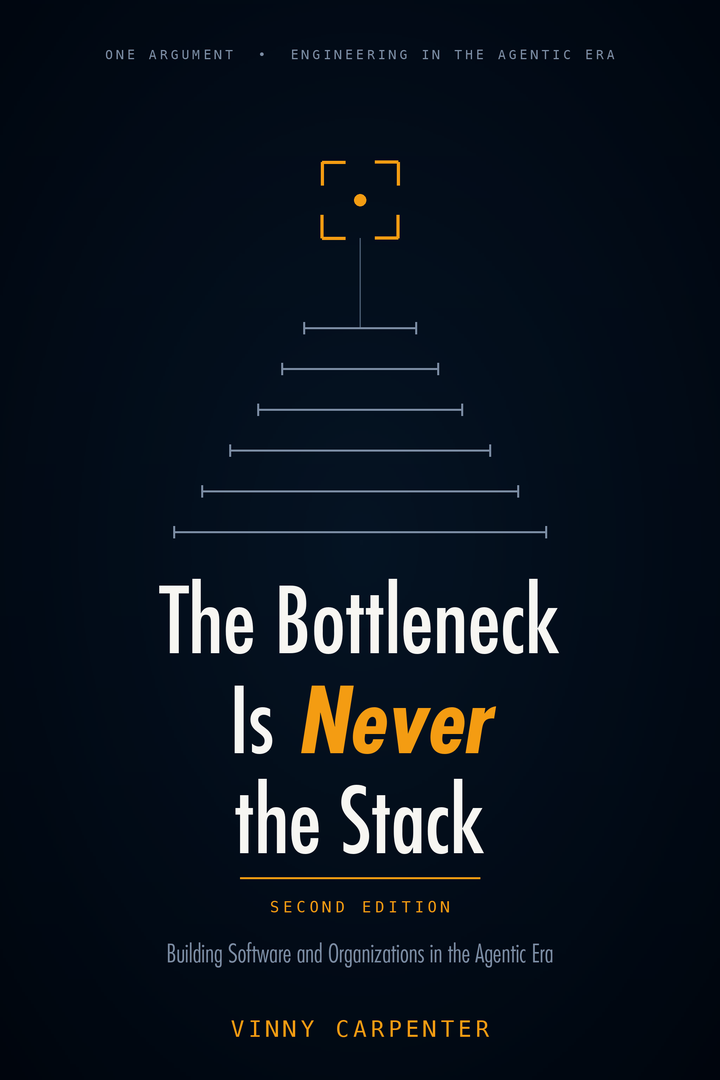
The Bottleneck Is Never the Stack
Building Software and Organizations in the Agentic Era
Execution got cheaper. Clarity did not.
AI did not create the real bottleneck in software. It made the old one impossible to hide.
Brookfield Press · Second Edition · Kindle, paperback & hardcover · 204 pages
the reviews
What Kirkus says
A new take on the AI debate with an intriguing framework for implementation.
“Carpenter brings his 30 years of experience as a software engineer oriented toward mindful, people-first leadership to provide a fresh take on a familiar argument.”
Read the full reviewabout the book
What it argues
For decades, engineering organizations treated code as the durable asset and implementation speed as the constraint. In the agentic era, that assumption is breaking. When AI can turn a clear specification into working software with increasing speed, the scarce work moves upstream: framing the problem, defining intent, enforcing standards, evaluating outputs, and owning the consequences.
The expanded second edition of The Bottleneck Is Never the Stack is one continuous argument about building software when agents become part of the delivery system, then turning that system into an engineering operating model. Written primarily for engineering and platform leaders in medium-to-large organizations, it also shows smaller teams how to combine the same responsibilities without copying enterprise ceremony. The next advantage will not come from chasing the newest tool, model, framework, or cloud service. It will come from clearer specs, stronger systems, better judgment, and operating models that make good decisions repeatable.
This is not a tool survey. It is an operating argument and field guide for leaders and builders trying to make AI useful without turning their codebase, culture, or delivery process into a faster mess.
The bottleneck is never the stack. It is the clarity of intent, the discipline of decision, and the quality of the conversation about what we are actually building.
second edition
What this edition adds
- 01
The argument now runs end to end: five parts and seventeen chapters instead of four and eleven, at 204 pages.
- 02
The back half is the expansion. Eight chapters take the loop from one team to the enterprise: readiness, work redesign, the org model, roles and apprenticeship, governance, the scorecard, and the roadmap.
- 03
Evidence gates hold it together: advance, hold, or stop, recorded before enthusiasm becomes policy.
- 04
The Operating Kit appendix maps the twenty-four artifacts the operating model runs on.
inside the book
Seven arguments it makes
- 01
Why the spec is the product, and the Context Spine makes intent durable
- 02
Why evaluation capacity, not generation, sets your safe adoption speed
- 03
How the confident defect ships, and how the intent chain finds the link that failed
- 04
How evidence-gated scaling carries a bounded pilot to a defensible scale decision, with advance, hold, or stop recorded before enthusiasm becomes policy
- 05
How platform teams encode standards, security, and compliance into the paved path
- 06
What humans still own when execution becomes cheaper
- 07
Why leadership in the agentic era requires honesty about the work AI reshapes
the chapters
Five parts, one argument
It opens with a short guide to using the book and an introduction, then moves through five parts, from one team to the enterprise.
the big picture
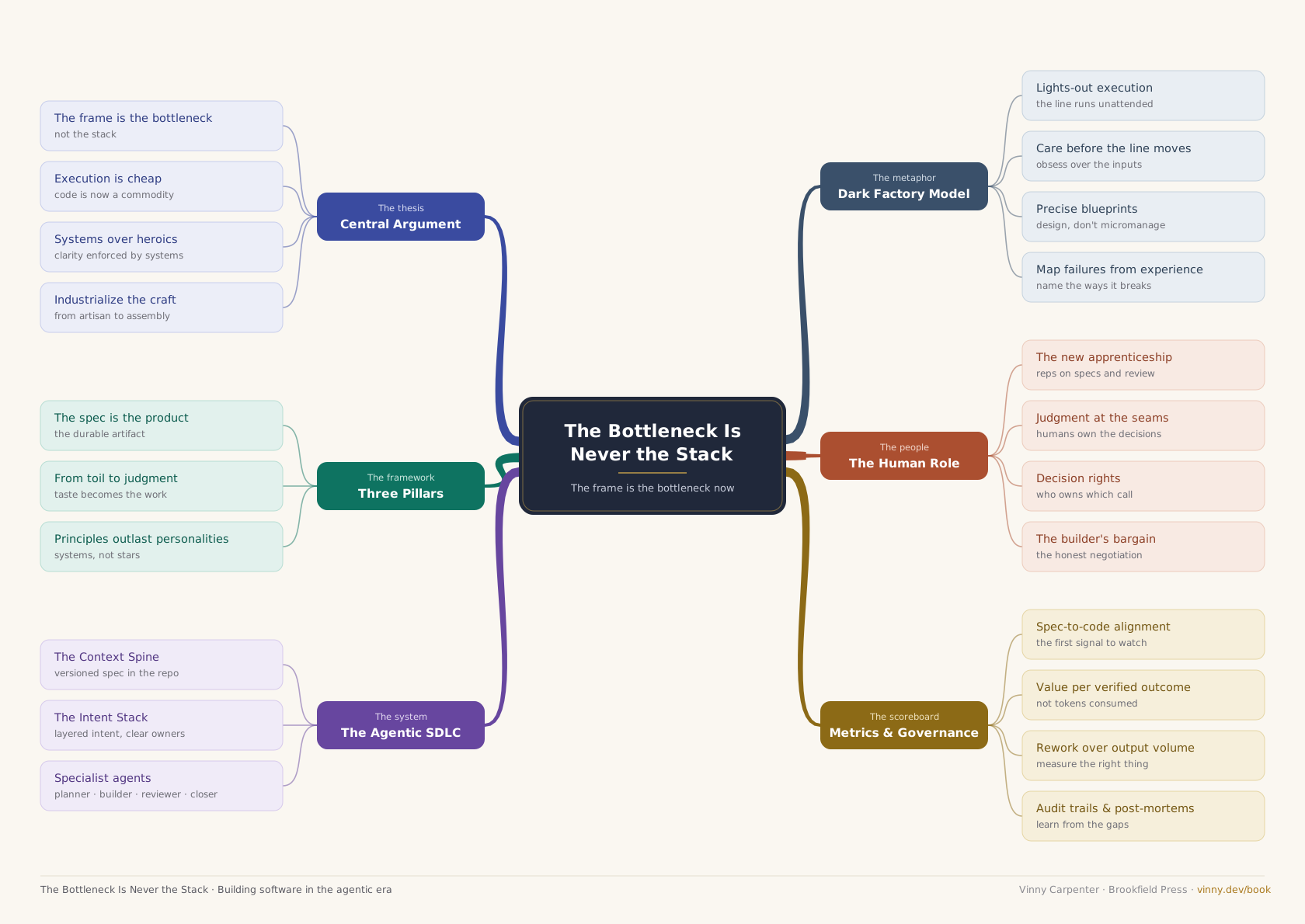
See the whole book as one mind map
Six branches on one page: the five parts, from the new bottleneck to the bargain, plus the Operating Kit appendix and companion workbook.
View the mind mapOpening
How to Use This Book
Read the argument in order once. Return by the decision in front of you.
The Bottleneck Is Never the Stack
A year of writing, one argument, and a working theory of where software is going.
Part I · The New Bottleneck
The Frame Is the Bottleneck
As agents get better at execution, the constraint moves upstream to the human framing of problems.
The Dark Factory Model
The lights are off because the controls are on. Dan Shapiro's dark factory, StrongDM's working version, and what the model demands before you trust it.
Part II · The System
The Agentic SDLC: Uniting the AI Tool Sprawl
Every tool in your pipeline is now an AI agent trying to do everything. Here is how to draw the boundaries.
The Spec Is the Product
Code used to be the durable asset. In an agentic SDLC, the code is exhaust and the spec is the product.
Spec, Standards, Specialists: How I Actually Build with AI
One spec, one standards file, a handful of specialist agents: the whole workflow, including the five costs it charges.
Part III · The Practice
Worked Example: From Vague Request to Governed Release
A composite notification-preferences feature, traced through a proposed delivery path.
The Confident Defect
The worked example showed the intended loop. This one shows what happens when it fails, and how mature incident practice extends to an agentic system.
Pipeline-First Is Not a DevOps Initiative
The technical case is easy; the human case decides it.
Part IV · From One Team to the Enterprise
Day 31
The loop is clear at one-team scale. The next problem is making it repeatable across an institution without scaling confusion faster than clarity.
Where You Actually Are
Five conditions decide whether the operating model takes root or gets rejected. Assess them before you announce anything.
Redesign the Work at Enterprise Scale
Workflows become paved paths, decision rights become policy, ownership becomes inventory, and evaluation becomes the instrument panel. The org chart still moves last.
The Org Model: Structure Follows Evidence
Team shapes, the AI engineering capability, and federated standards: how to draw the boxes once the redesigned work has told you where they go.
Roles, Careers, and Apprenticeship
The four responsibilities the operating model creates, the apprenticeship it almost destroys, and the capacity the institution has to fund for real.
Governance That Ships
Provenance, liability, model risk, vendors, and the control environment around generated code.
The Scorecard: Measuring Evaluation Capacity, Not Activity
The instruments that tell you whether the operating model works, the one-page scorecard executives review, and the gaming the design has to survive.
The Roadmap: From One Team to the Portfolio
Four phases governed by evidence gates. Growth is a consequence of health, not a schedule.
Part V · The Bargain
The Bargain Underneath
The subsidy that made AI feel free is ending, and the full costs of inference, supervision, lost judgment, and workforce transition are becoming visible. The bill lands on the people building the systems.
the companion
Run it as a working session
free facilitator workbook
Putting the Book to Work
Five working modes, two linked pilot charters, all twenty-four Operating Kit artifacts as blank forms, and completed Harborline examples.
Get the workbookFree PDF · no email requiredformats
Three ways to read it
Kindle ebook
ISBN 979-8-9964640-7-4
Paperback
ISBN 979-8-9964640-6-7
Hardcover
ISBN 979-8-9964640-8-1
The Amazon links on this page are affiliate links. I earn a small commission at no extra cost to you.
the author
Who wrote this
Vinny Carpenter has spent more than thirty years building software and leading platform and engineering teams. He is a Vice President of Engineering at a Fortune 100 company, leading Cloud, Platform & DevOps.
He writes at vinny.dev on agentic development, spec-first delivery, and the human bargain behind automation. This book grew out of that public writing practice: a year of essays sharpened into one argument. He lives in Brookfield, Wisconsin.

Start where the book started
The book grew out of a year of essays. Read the one that first named the argument, then take the whole thing with you.
where the royalties go
I didn't write this book to make money. I wrote it to prove something to myself and to put down ideas I'd been circling for years.
So the little it earns should do some good. 100% of my royalties from this book go to Girls Who Code. They help young women build the skills and confidence to thrive in tech.
If this book nudges one more person toward building, and helps fund a few more who want to start, that's a trade I'll take. Thank you for reading.