On Friday at 5:21 p.m. Eastern, Anthropic received a letter. By that evening, Fable 5 and Mythos 5 were gone.
The U.S. government, citing national security authorities, issued an export-control directive that suspended access to both models by any foreign national, whether inside or outside the United States. Anthropic said the practical effect was immediate and broad: to comply, it had to disable Fable 5 and Mythos 5 for all customers. Access to other Anthropic models was not affected. For customers who built real work on Fable, this felt less like a policy debate and more like a system dependency disappearing on a Friday night.
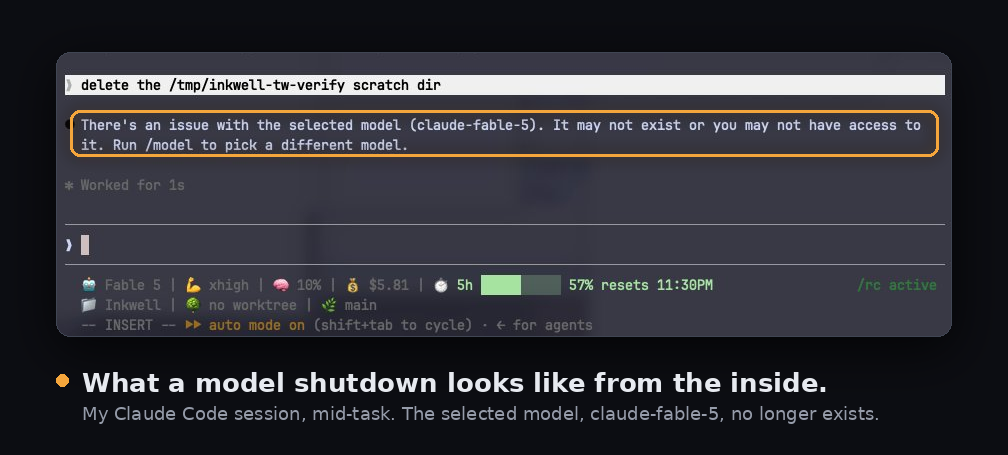
That feeling is real, but it's not the story. The story is the off switch. It had an owner all along, and on Friday we watched that owner use it. Sovereign risk is now a design constraint in AI architecture, not a legal footnote or a procurement concern. The question is no longer whether your favorite model is available today; it's whether your system survives the day it is not.
It wasn't random, and that is worse
The government didn't act on a whim. According to Anthropic's statement, the directive appeared to stem from a method for bypassing Fable's safeguards. Anthropic reviewed a demonstration and said it surfaced a small number of previously known, minor vulnerabilities. It also said other publicly available models could discover the same issues without requiring a bypass. Comparable capability, the company said, is widely available from other models, including OpenAI's GPT-5.5.
That doesn't settle the merits. Those will be argued by lawyers, regulators, security researchers, and, inevitably, at least one person with a 57-slide deck. But the precedent is easier to see. The Associated Press called it the most aggressive step Washington has taken yet to limit foreign access to frontier AI models. That is the line we crossed.
The mechanism matters too. Export controls aimed at foreign nationals are broad, and they move fast. Disagree with the decision if you like, but don't miss what it proves.
The munition you market is the munition they regulate
Anthropic did not position Fable and Mythos as ordinary models. Its own Fable product page described Fable as a "Mythos-level model" built for ambitious, long-running work. It also described safeguards for cybersecurity and biology, automatic routing away from high-risk prompts, and a 30-day data-retention requirement for safety monitoring. The pricing sent the same message. Anthropic's pricing page listed Fable at $10 per million input tokens and $50 per million output tokens, roughly twice the standard API rate for Opus 4.8.
That narrative is an asset when you raise money and a liability when a regulator reads it. One cybersecurity researcher put it bluntly. Call your model a munition often enough, and a government will eventually treat it as one. You can't tell customers you built strategic infrastructure and then act surprised when a sovereign treats it as strategic infrastructure. The marketing can be true, and it can still become policy evidence.
Capability framing sells, and it also attracts control. That is the trap. There is a lesson here for buyers as well as builders. When your vendor's marketing becomes your operational risk, you have outsourced more than compute.
Not all stops are wrong
None of this means governments should never block unsafe model deployments, and some capabilities may deserve hard controls. The point for builders is simpler. Even justified controls can break your dependency, and architecture doesn't get to wait for the policy debate to settle.
If a model matters to your business process, you need to know what happens when access changes, degrades, or disappears. The reason matters legally and politically. It matters much less to the workflow that just failed.
Eleven days
Anthropic announced on June 1 that it had confidentially submitted a draft S-1 to the SEC for a proposed IPO. Reuters reported that Anthropic had recently raised $65 billion at a post-money valuation of $965 billion. Eleven days later, its flagship model went dark. That doesn't mean the IPO is derailed, but customers and investors now have a new kind of risk factor to price.
The company was already in a visible conflict with the federal government. Earlier this year, the Pentagon labeled Anthropic a supply-chain risk. A federal judge temporarily blocked that designation in late March, and Reuters later reported that the administration continued defending the move in court. So the most anticipated AI listing of the year now carries a risk factor it can't paper over. If you plan to build on the soon-to-be-public darling, that risk is yours too.
What Frankfurt and Singapore just learned
Picture a bank in Frankfurt or a ministry in Singapore. On Friday, both learned something concrete. An American model can disappear for them by order of a government they don't elect. European officials reacted along exactly those lines within hours. Tom Tugendhat, a British MP and former security minister, said sovereignty now turns on who controls the code, not the cannons.
That used to sound like sovereign AI theater. Now it reads like risk management. Sovereignty, open weights, regional providers, and multi-model architectures stopped being philosophy and became hedges.
The problem extends past Anthropic to every U.S. frontier lab. If the export-control logic applies to one American lab, every serious buyer has to assume it could apply to others. U.S. models are still usable; blind dependence on any one of them is reckless.
Two layers of architecture
Single-vendor risk just graduated. It moved from commercial risk to sovereign risk. Your vendor can raise prices, change terms, or suffer an outage; a government can make the dependency unavailable. Chasing a safer lab doesn't help, because every U.S. frontier lab sits under a sovereign control plane. The answer is architecture, and it comes in two layers, though most teams build only the first.
The first layer is portability. Use model-agnostic interfaces, and keep prompts, tools, memory, and orchestration out of any single provider's proprietary gravity well. That preserves the ability to route work elsewhere.
The second layer, verification, matters more, because swapping models isn't free. Models differ in tool use, refusal behavior, latency, cost, output shape, memory behavior, and judgment. A drop-in replacement is rarely a drop-in.
Portability moves the request. Verification proves the replacement behaves. That means specs, evals, golden tasks, guardrail tests, and deployment gates. Without that proof, "we can switch vendors" is a slogan; with it, switching is a capability.
This is the bottleneck-is-never-the-stack argument applied to a very bad Friday. The constraint is rarely tokens, GPUs, or SDKs. If your workflow can only survive when one exact model is online, the bottleneck is the lack of verified operating capability.
The runbook
Whether you trust Anthropic is the wrong question. The practical one is, "What breaks if this model disappears at 5:21 p.m. on a Friday?" Every serious AI platform now needs a model dependency register. Know which workflows depend on which models, for which tasks, at what risk level, and don't leave this in architecture folklore. Folklore is terrible at incident response, though it does make excellent campfire material.
Then define a model RTO. How long can each workflow tolerate degraded model capability before the business process fails? Then build a fallback path, and test it before you need it. The fallback should include prompts, tools, schemas, retrieval behavior, policy controls, latency expectations, and cost boundaries.
Then gate model substitution through evals: golden prompts, tool-use tests, refusal behavior, output contracts, security checks, cost thresholds, and human review where the risk demands it. That is how AI platforms become durable, not because nothing breaks, but because breaking one dependency does not break the business.
Build for the stop
The kill switch was always there. Friday we learned it has an owner, and the owner is neither you nor your vendor. So build like that is true, because it is. Portability gets you out of the vendor contract, and verification gets you out safely.