I already had a working app. I rebuilt it anyway. Twice.
GSD, short for Get Stuff Done, started as a web app and ran that way for a couple of years. It did the one job I built it for. Then I wrapped it as a PWA so it would follow me onto my phone, and that worked too, in the way something works when you've decided not to look at it too closely. Then, knowing almost to the hour what it would cost, I tore the mobile experience down to the studs and rebuilt it as a native iOS and Mac app. The obvious version of this story is vanity.
The rebuild looks like a platform story, but the platform only changed the surface. What changed the outcome was the discipline underneath. The stack made the experience possible, and the boundaries made it safe. What I'm keeping from it has little to do with Swift or widgets, or with the warm glow of finally belonging on the phone, though I'll admit the glow is pleasant. It's that one person, with an AI agent doing most of the typing, can ship a real product only when the intent is clear, the architecture enforces the rules, and the verification loop is fast enough to keep everyone honest.
The bottleneck was never the stack. It was whether the product's intent had been encoded into durable boundaries before the speed arrived.
The web app that grew up
GSD is an Eisenhower-matrix task manager. That is the whole premise. Every task gets placed on two axes, urgent and important, and falls into one of four quadrants: do first, schedule, delegate, or eliminate. The job to be done is decide what matters, then act, and keep that decision honest as the day changes.
I built it for a reason I confessed a while back. I'm a procrastinator who had tried every task app under the sun, and none of them was the one. Every app was either a notebook with checkboxes or a project-management cockpit with 40 buttons. I wanted the 2×2 grid to be the entire surface, and everything else to live one layer down: recurrence, subtasks, dependencies, time tracking, analytics, import, and export. Reachable, but never crowding the one question I open the app to answer: what do I work on next?
Over two years it grew the way useful software grows. Natural-language capture came first, so I could type a task and let punctuation do the sorting instead of filling out a form. Then came recurring tasks, subtasks, time tracking, smart views, and a dependency graph, so "ship the release" could know it was blocked by "finish the changelog." Import and export followed, because it was my data and I wanted it to stay mine. It was offline-capable, it was fast, and it was the tool I actually used every day.
That last part is the trap. When the thing you built is the thing you use, "good enough" stops being a verdict and becomes a habit.
The PWA was a polite lie
I wanted GSD on my phone, and the honest, cheap, responsible answer in 2023 was a Progressive Web App. Add to Home Screen, a service worker for offline, and a manifest so it got an icon and launched without browser chrome. On paper, a native-feeling app for the cost of a config file.
It was fine. It was also a polite lie, and the lie lived in the phrase "native-feeling."
A PWA can render almost anything a browser can render, which is nearly everything. What it can't do, at least not in the way this app needed, is belong to the phone. The things that make a mobile task manager frictionless are precisely the things that sit deepest in the operating system:
- Capture has to be instant, from anywhere. The whole point of an Eisenhower box is to catch a thought before it evaporates. On a real phone that means a Home Screen widget, a Lock Screen widget, a Share Sheet entry so you can throw a link or a selection straight into the inbox, Siri, Shortcuts, Spotlight, and App Intents. With the PWA, capture meant unlock, find the icon, wait for the web view, tap the box, and by then half the thoughts were already gone. Capture can't be a scavenger hunt.
- It never stopped feeling ported. Scrolling had the wrong inertia, the keyboard covered the wrong things, and swipe gestures fought the browser's own. Every interaction was a translation, and you could feel the seams.
- The platform kept it at arm's length. Web push and badging exist now, and for many apps that's enough, but notification was never GSD's problem. It needed native capture surfaces that felt like part of the system instead of a detour through a browser. In a task manager, those are the product.
All of that is the boundary of the medium. A PWA is a website that has been allowed to sit closer to the Home Screen. That is useful, and sometimes it's exactly the right trade. But a task manager you reach for 30 times a day needs to be a citizen of the device.
So the question stopped being whether the PWA was good enough. It was good enough, and good enough turned out not to be what I wanted from the tool I rely on most.
Native, not ported
The temptation, once you decide to go native, is to port. Take the web layouts, the web components, and the web mental model, then transliterate them into Swift. It's faster. It's also how you end up with a native app that feels exactly as ported as the PWA did, just compiled.
I set one rule before writing a line of the rebuild: reimagine around the platform, do not transliterate the web.
Concretely, that meant a few non-negotiables.
iPhone and iPad are co-equal, first-class targets. iPhone gets a TabView, and iPad gets a NavigationSplitView with a sidebar and a detail pane. Each is laid out for its own size class rather than scaled until it stops looking wrong.
The interactions are iOS interactions: swipe actions on cards, context menus on long-press, drag-and-drop to move a task between quadrants, a ⌘K command palette on the keyboard, widgets, and App Intents. The capture box is always one tap away. The punctuation shorthand does the classifying, with a bang for priority, an asterisk for a subtask, and a #tag to file it, so you never touch a form just to add a task.
And one principle shaped the architecture more than any other: privacy is the product, not a setting.
This wasn't a new idea bolted on for the rebuild. The first web version already kept everything local in the browser, with no tracking, no accounts, and no cloud. The promise was there from day one, and every addition since has honored it. The rebuild is where it stopped being a promise and became something the architecture enforces.
GSD is offline-first as a correctness constraint. The app is fully usable with no account and no network, and all your data lives on the device. Cloud sync, bidirectional with the encrypted backend I built for the web app last year, is strictly opt-in, and your data sits behind passphrase-derived keys that I never hold. The UI is never allowed to imply your data has left the device when it hasn't. That is an engineering specification, and it dictated where every byte was allowed to live.
The dependency direction is the design
This part looks like Swift trivia, and it's load-bearing. If you never write a line of Swift, stay with me, because the principle is portable: enforce your architectural boundaries in tooling, so they can't be crossed by anyone. That includes you, and it includes an agent that has no memory of why the boundary exists in the first place.
All of GSD's real logic lives in a layered Swift package, GSDKit. The app itself and its two extensions are thin shells on top. The layers are ordered, and the order is the design. Each layer is only allowed to depend downward:
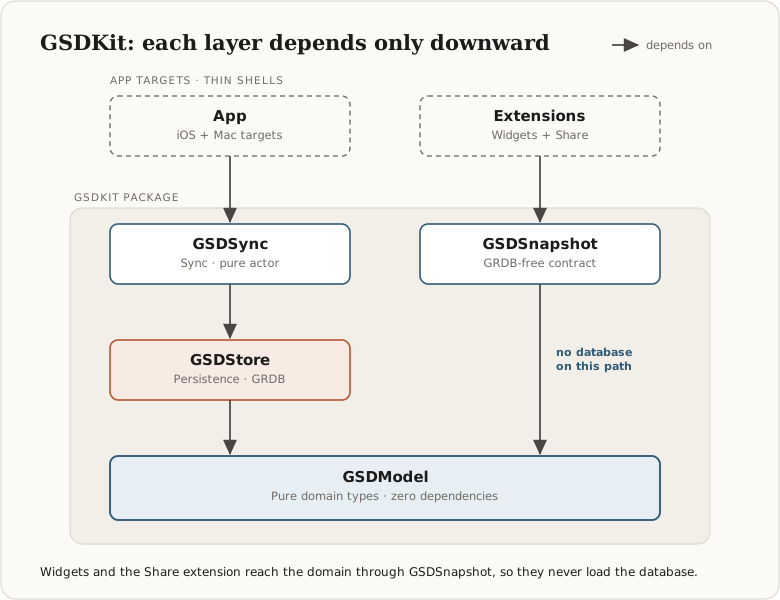 GSDKit's layered package. The manifest enforces the arrows, so no layer, and no agent, can depend upward.
GSDModel is the domain. The Task, the four quadrants, the capture parser, the recurrence engine, and the dependency graph live there. It has zero dependencies, enforced by the package manifest, so you physically cannot import the database into it. That constraint is the point. The rules of the product cannot get tangled up with how the product is stored.
GSDStore owns persistence with GRDB and exposes exactly one way to change a task: a single TaskStore that every mutation flows through. There is no other path. When anything changes a task, TaskStore stamps its updatedAt from an injected clock and enqueues it to the sync queue, in that order, every time. A single mutation path sounds like bureaucracy until you realize it's why sync is trustworthy. There is exactly one place where "a thing changed" is true, so there is exactly one place that has to be correct.
GSDSync is a pure actor. The pull, push, deletion-reconcile, and last-write-wins logic all live there, unit-tested with no network and no simulator. The untestable glue lives up in the app as a separate coordinator: when to sync, watching the network path, and reacting to the app returning to the foreground. The tested core stays pure. The messy timing stays quarantined.
GSDSnapshot is the quiet hero. It's a GRDB-free contract that the widgets and the Share extension talk to, so the extensions can share real logic with the app without ever pulling the database into their process. An iOS extension is a tight, memory-constrained little thing, and you don't want a full SQLite stack loading inside your Lock Screen widget. The snapshot layer lets the extensions be first-class without being heavy.
The fast feedback loop falls out of this for free. Because the logic has no UI and no backend bolted to it, the entire test suite runs in under a second from the command line, with no simulator boot and no build-and-deploy. I could change the recurrence math and know in a second whether I had broken month-end rollover. That speed is what let me move fast without breaking the tool I use every day.
The compiler and the package manifest enforce every one of these boundaries, so none of them depend on my good intentions. That distinction is why the next part of the story worked.
The clock that lied
Let me make the architecture concrete with the bug I'm fondest of. It's the kind of bug you only get to have once you're syncing real devices in the real world.
Sync is last-write-wins. Two devices edit, the most recent edit wins, and "most recent" is decided by a timestamp. Simple, until you ask the obvious question: whose clock?
My first cut trusted the device clock and used it to drive the pull cursor, the marker that says "give me everything changed since X." This works perfectly right up until a device's clock is wrong, which devices' clocks routinely are, by seconds or minutes.
The failure mode is silent and nasty. If a device thinks it's slightly in the future, it asks the server for changes since a moment that hasn't happened yet. The server truthfully answers "nothing," and pulled changes quietly vanish with no error and no crash. A task you completed on your phone simply never shows up on your iPad, and you have no idea why.
The fix is a one-line idea that takes real care to get right: never trust the local clock for the cursor. Advance the pull cursor using the server's stamp on each record, not the device's. The server is the only clock all devices agree on, so it's the only clock allowed to decide what "since" means.
Once the cursor follows server time, device clock skew can no longer lose a pull. The worst it can do is resolve a single conflict the wrong way, which last-write-wins is allowed to do, instead of silently dropping data, which it is never allowed to do.
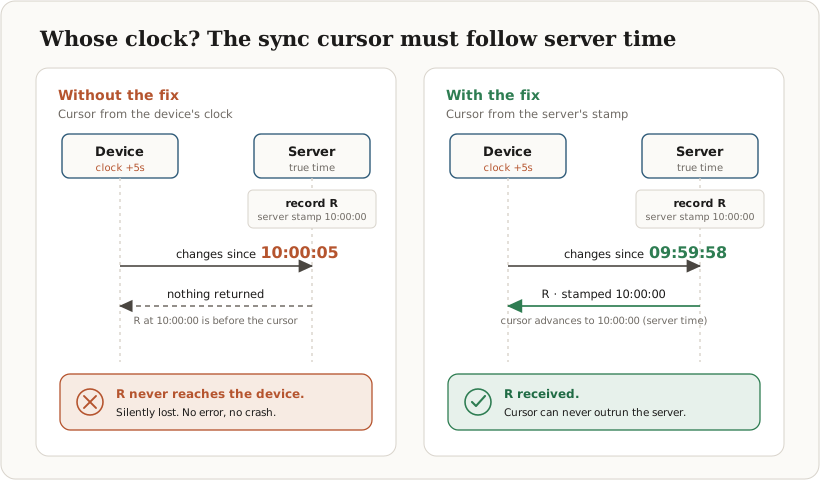 The sync cursor, before and after. Driven by the device clock it silently drops pulls; driven by the server's stamp it cannot.
That is the whole reason the architecture is shaped the way it is. The sync engine is a pure, testable actor specifically so that a subtle, timing-dependent, data-losing bug like this can be reproduced and pinned in a unit test that runs in milliseconds, instead of being chased across two physical devices and a flaky network.
There is a native-only sibling to this story I'll spare you the depth of: 0xDEAD10CC, the exception iOS throws when an app holds a database file locked while suspended in the background. A widget timeline refresh or a background Siri write can wake just enough of your app to touch the database at exactly the wrong moment. The fix is to observe the system suspending the database and back off gracefully. You don't get bugs with names like that on the web. They're the toll you pay for living on the device.
Spec, plan, execute, on repeat
This is where the earlier boundary point becomes practical. I built almost all of this with an AI coding agent, though not the cliché version where the AI writes your app while you watch. What I did was more deliberate, and more interesting.
The mistake people make with coding agents is treating them like a vending machine. Describe a feature, receive a feature, paste it in, repeat. That scales to toys and collapses on anything real, because there's no through-line. Every interaction starts from zero, the architecture drifts, and three weeks in you have a pile of plausible code that doesn't cohere.
What worked was imposing a rhythm and never breaking it. Every meaningful chunk of GSD went through the same three beats:
- Spec. Before any code, write down what we're building and why as a design document: the behavior, the edge cases, and the constraints. The point was shared ground. The agent and I had to agree on what "done" meant before "how" was on the table.
- Plan. Turn the spec into an ordered implementation plan, with the steps in sequence and each step small enough to verify on its own.
- Execute. Work the plan one verifiable step at a time, with the sub-second test suite as the gate between steps.
To make that concrete, one loop in the commit log looked like this: a commit reading docs: sync engine design, then docs: sync implementation plan, then a run of feat: commits working the plan one step at a time, then a test: commit that pinned the clock bug above so it could never come back.
Scroll the whole history and you see that shape repeat. Foundations, then the core matrix, then task depth, then filtering and smart views, then the editorial redesign, then sync hardening, then Sign in with Apple, then widgets and Siri, then the Mac port. Each phase had its own small spec, plan, execute loop.
Two things made the difference between this being a force multiplier and being a mess generator.
The first is that the architecture did the agent's homework for it. Those rigid layer boundaries are good design for humans. They are also guardrails for an agent: the manifest that forbids importing the database into the domain, the single mutation path, and the pure sync actor. When the compiler and the package manifest enforce the rules, an agent can't drift across a boundary it shouldn't cross, no matter how confidently it tries.
The constraints that make the code testable are the same constraints that make it safe to generate.
The second is that I kept a written record of why. The code already says what. Alongside the code there is a log of the reasoning behind decisions, the reason each file is shaped the way it is. When you come back two months later, or when the agent comes back with no memory of the last session, that log stops you from re-litigating a decision you already made carefully the first time.
I want to be precise about my role, because it's easy to mythologize this in either direction. I did not write most of the lines. I also did not get to stop thinking. I wrote the specs, I made the architectural calls, and I caught the clock bug by asking "whose clock?"
That is a question rather than a keystroke, and it's the kind of question the whole thing lived or died on. The agent was extraordinary leverage on clear intent and roughly useless without it. It typed faster than I ever could, and it never once decided, on its own, what the product should be.
If you want one line to take to work on Monday, take this one. An agent respects the boundaries your tooling enforces and ignores the ones that live only in a senior engineer's head. Build the first kind.
The unglamorous miles
The app is the easy part. Shipping it is a long, unglamorous tail, and native makes you walk every step of it.
The web app deploys when I push. The native app has to be archived, signed, uploaded, and reviewed, on two platforms, against rules that exist whether or not they make sense for your app. I automated what I could: a release script bumps the version, archives, exports, and uploads to TestFlight for both the iOS and Mac Catalyst builds. Automation removes the typing. It does not remove the requirements.
A sampling of the miles, none of which a PWA would have charged me for:
- Mac Catalyst. "Universal" sounds free until you build it. The Mac build needed real menu-bar commands, a sensible minimum window size, an About panel, and a careful exclusion of the iOS-only extensions from the Mac target. It also grew its own species of bug, like a web-auth callback that arrives off the main thread through Catalyst's XPC plumbing.
- In-app account deletion. App Store guideline 5.1.1(v) is blunt: if a user can create an account, they must be able to delete it from inside the app. So there is now an ordered remote-then-local deletion flow with a confirmation, an entire feature built to satisfy a rule that, to be fair, is the right rule.
- Export compliance. Every upload asks whether your app uses non-exempt encryption. For GSD, the answer was no non-exempt encryption, only ordinary HTTPS, and a single Info.plist key tells App Store Connect that, so builds go straight to testing instead of stalling on the same question every time.
- A marketing demo, built like software. Even the promo video became a small engineering project: a seeded demo state behind a launch flag, an automated UI test that choreographs each scene, simulator screen recordings, and ffmpeg stitching it into a captioned 16:9 cut. Of course it did. Once you have the discipline, you point it at everything.
This is the part of "native, not ported" that doesn't show up in the demo. Belonging to the platform means living by the platform's rules, and there are a lot of them. I knew that going in, and it's part of what I meant by on purpose.
The objection I would raise too
Every word of this is about a personal app I control, and that is the objection I would raise myself. No team, no deadline, no stakeholders, no roadmap to negotiate, and full license to overbuild a tool that serves exactly one user. Most engineering doesn't get to take the long way around, and a clean result from a one-person project proves less than it looks like it proves. All of that is true, and I have two responses.
First, the native path was the expensive one on purpose, and I knew there were cheaper ones. A cross-platform native framework would have bought back a lot of time. I skipped it because the integrations I cared about most, widgets, Siri, Spotlight, App Intents, and a Share Sheet that feels native, are the ones those frameworks tend to fight hardest. That was a deliberate trade for this specific tool, not a claim that everyone should make it.
Second, and this is the part that matters, the thing that generalizes is the discipline rather than the native craft. The constraints that let me move fast alone are the same constraints that keep a team of 50 from drifting, which means they matter more under real deadline pressure, not less.
Point an agent at a clean codebase and you get leverage. Point one at a sloppy codebase and you get the leverage to make a bigger mess faster. The part of this project worth copying is the boundaries, the single obvious path, the fast verification loop, and the written record of why. None of those required unlimited time. They are how you make speed safe.
The slower path, on purpose
I had a working app, and I spent months rebuilding the mobile experience from scratch, in a new language, against two platforms' worth of rules, to arrive at software that does the same job the PWA already did.
The PWA answered one question: can I use GSD on my phone? Native answered a better one: does GSD belong on my phone? The gap between those two questions is the reason I did it. Capture is now a widget tap or a sentence to Siri, fast enough that the thought survives the act of catching it. The app scrolls and swipes and feels designed for iOS because it was designed for iOS instead of translated into it. My data lives on my device, provably, with sync as a choice I make rather than a default I have to trust. And the same matrix is now at home on a phone, a tablet, and a Mac, each laid out for what it is.
Good enough is a trap precisely because it's true. The PWA was good enough, and I rebuilt it natively anyway, because the tool I reach for 30 times a day was worth it. What I have now is a clean, layered, tested core, and proof of how it behaves under an agent. That is the part worth copying, whether or not you ever take the long way around yourself. Look at the boundaries in your own system and ask whether your tooling enforces them, or whether you're simply trusting everyone to remember.
Related reading
- The Frame Is the Bottleneck. Why the constraint moves from execution to the human framing of the problem as agents get better at the typing.
- Spec, Standards, Specialists: How I Actually Build with AI. The working loop behind the spec, plan, execute rhythm in this post: a refined spec, a layer of standards, and coordinated specialists.
- Eleven Years, One Week, and an AI Co-Pilot: Rebuilding TravelTimes for iOS. Another long-lived app rebuilt with an agent in a focused sprint, including the parts the agent got wrong.
- Building My Own Productivity Tools: A Procrastinator's Journey. Where GSD began. A procrastinator's confession, two privacy-first web apps, and the local-only promise this rebuild finally hardened into architecture.
- From Procrastination to Privacy-First Productivity (Part 2). The middle chapter. GSD gained the optional encrypted cloud sync this native app now uses, plus an MCP server so the tasks could talk to an AI assistant.