I didn't set out to start a podcast. Think of it as a personal blog nobody asked for, except now you can't even skim it.
The story starts with NotebookLM, which Google renamed Gemini Notebook in July 2026. I will use the old name here, since that is what it was called while all of this happened. NotebookLM is a research tool built around source grounding. Give it documents, websites, videos, recordings, or other material, and it can synthesize those sources into summaries, reports, and audio and video narratives.
For me, one feature carries the whole product. Audio Overview turns your sources into a Deep Dive discussion between two AI hosts. The hosts sound genuinely delighted by whatever you uploaded. Give them a tax document and they will find the drama in it.
My blog posts kept getting longer. "Where the Saved Hour Goes" ran 2,600 words, which is a lot to ask of anyone's lunch break. So I started attaching an Audio Overview to new essays, usually about 20 minutes of conversation for the commute, the gym, or the dog walk. The hosts have never once complained about my word count, which puts them ahead of nearly everyone I know.
Then I did what I always do with a manual step I have repeated twice. I automated it.
Every post I publish now kicks off a pipeline. Publishing the Markdown file is the trigger. From there, the workflow submits the essay to NotebookLM, generates the Audio Overview, downloads the finished audio, and attaches the player to the post. Once I publish the essay, I do not have to remember that the audio version exists.
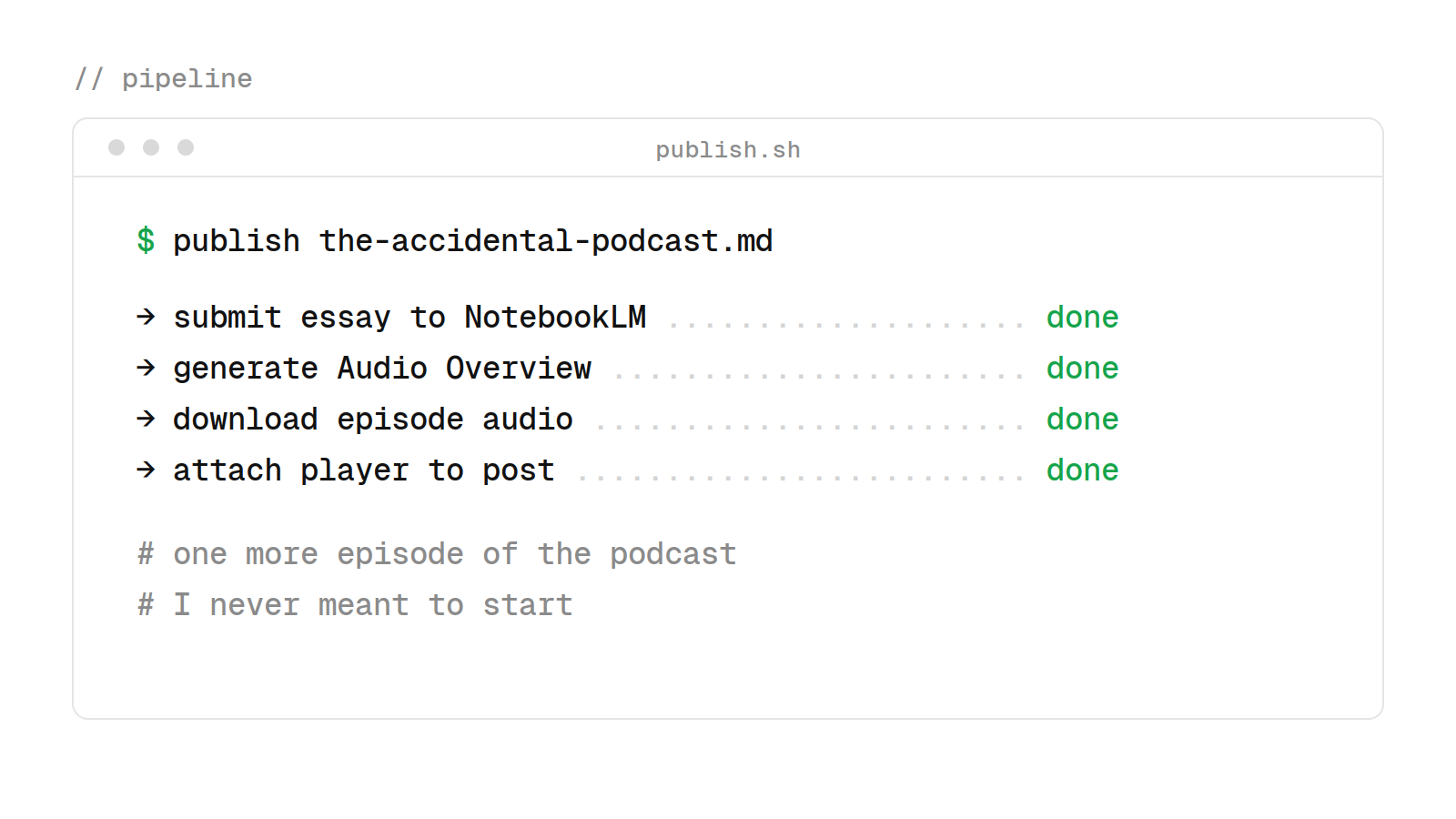
There is nothing especially profound about the plumbing. The interesting part is what the plumbing removed.
Automating the step did more than cut the work of producing an audio version; it removed the decision to produce one.
That means I built a fully automated podcast production pipeline before I ever decided to have a podcast. I choose to call this foresight.
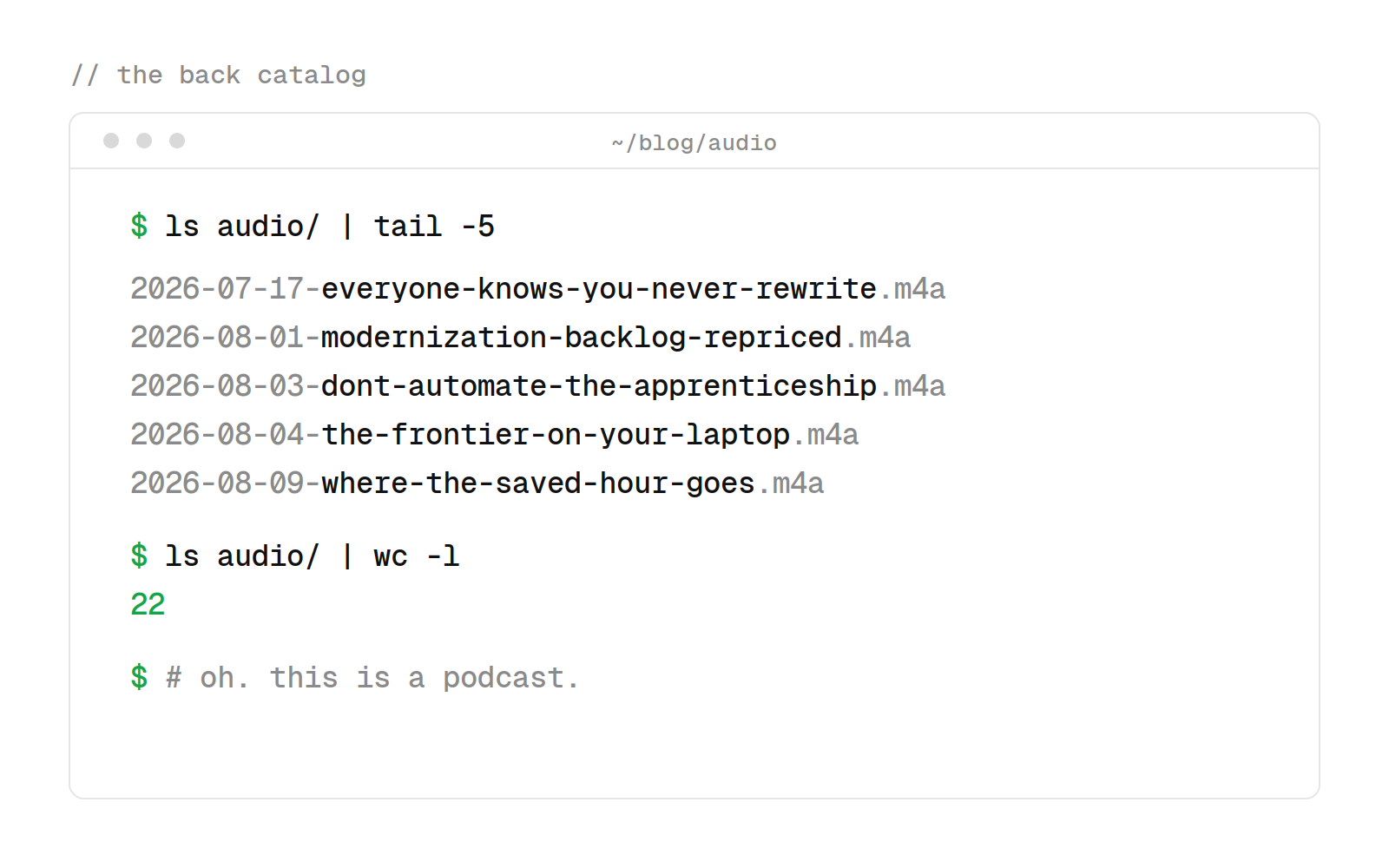
Last week I was reviewing the audio for a new post and opened the folder where the files land. It held 22 episodes going back to April. Same format, same two hosts, no missed deadlines. Somewhere along the way I had accumulated a back catalog.
The show was already running. It had just been too polite to announce itself.
So I am making it official.
I named the show Never the Stack. The name comes from the argument that runs through the book and much of my writing: the bottleneck in software has never been the stack. The 22-episode archive becomes the launch catalog, and a new episode will arrive automatically whenever I publish. The hosts are AI, the production is a pipeline, and the author mostly stays out of the way, which may be exactly why it works.
I never decided to start a podcast. I lowered the cost of making one until it started itself.
That is the part I find more interesting than the podcast itself.
We tend to think about automation as a way to do the same work faster. Sometimes that is all it is. But when the marginal cost of creating something falls far enough, the effect changes. Work that once required a deliberate decision becomes cheap enough to happen by default. Artifacts stop waiting for permission and start accumulating.
That is the pattern I keep writing about, most recently in "Where the Saved Hour Goes". The saved hour does not simply sit there waiting to be reclaimed. Lower the cost of an activity and we often spend the new capacity before we even notice it exists.
In this case, my saved hour went into a pipeline, and the pipeline quietly turned into a show.
Never the Stack lives at vinny.dev/podcast, with links for Apple Podcasts, Spotify, YouTube, and Amazon Music, plus a plain RSS feed for the purists.
If you have ever wanted my writing read to you by two relentlessly upbeat AI hosts, this is your moment.
If you have never wanted that, I understand completely. The text version remains fully skimmable.