During a late-night Kubernetes network component upgrade, an engineer recommended rolling back. She wasn't convinced the team could resolve the issue inside the change window. What stayed with me was her willingness to say the plan might not work while there was still time to make a different decision.
I wrote about that moment in What the Rollup Leaves Out. It comes back to me when I think about architecture reviews. A runbook can identify an escalation path. A dashboard can name the owner. Neither, on its own, tells me whether an engineer can challenge the plan when the evidence changes. As we automate the review itself, that gap gets easier to overlook.
On November 16, AWS announced an update to the Well-Architected Framework. The update separates shared cloud foundations from individual workloads and reorganizes guidance for more automated assessment. AWS also retired certain standalone practices about business strategy, people, and organizational processes. Its explanation was straightforward: those questions depend on judgment and context that configuration and telemetry cannot fully capture, making automated reviews harder. AWS says it still offers that guidance through other resources.
I think that's a reasonable design choice. A machine should collect evidence it can inspect reliably rather than ask a tired team to repeat facts from memory. But a change to what a review asks should also change what we claim its result proves.
The risk isn't that AWS stopped caring about people. It is that readers may treat a narrower assessment as a broader assurance.
The update narrows what a review asks
The updated framework describes 45 Cloud Foundations practices across seven capabilities and 216 Cloud Workloads practices. The previous workload-oriented structure contained 307 practices. AWS says 33 foundation practices moved or merged from existing guidance, and it says the reorganization preserves technical coverage.
Those numbers don't mean AWS simply deleted 91 checks. Practices moved, merged, changed, or were retired. I haven't independently validated the claim of unchanged technical coverage.
The distinction between Foundations and Workloads makes sense. Account structures, identity controls, logging, network design, and cloud financial management are often shared capabilities. A workload team shouldn't need to reassess every landing-zone decision from scratch.
The update also makes room for more automated evidence gathering. That's useful progress. Agents can inspect deployed state, surface drift, and help reviewers spend less time reconstructing what exists. But the presence of 216 practices doesn't mean an agent can conclusively verify all 216 from configuration alone. Review coverage, permissions, context, and the evidence available still matter.
Neither the Well-Architected Tool nor the Well-Architected Agent certifies that an architecture is sound. Their findings help teams reason about risks. They don't eliminate that responsibility.
A dedicated question forces a direct answer
The February 2025 Operational Excellence guidance included explicit organizational questions about priorities, ownership, and culture. Among its practices were executive sponsorship, empowerment to act when outcomes were at risk, and encouragement to escalate. The older Cost Optimization guidance also included creating a cost-aware culture.
Some of those standalone titles are gone. Their underlying concerns are not. The old pages still load at their original URLs, but the reorganized pillar no longer lists them, and OPS03 now names a different capability.
The current framework still requires meaningful organizational behavior in several places. OPS05-BP04 discusses executive sponsorship for operational readiness. OPS06-BP03 calls for escalation paths that reach people with authority, access, and preapproved actions, supported by exercises and review. SEC11 addresses security ownership and the ability to delay unsafe releases. COST01-BP02 connects cost goals to shared accountability and engineering culture. PERF01-BP02 asks teams to evaluate tradeoffs against business priorities and record decisions.
These are substantial requirements, and calling them mere configuration checks would be unfair to AWS.
Still, I think something changes when a question loses its own place in the review. A dedicated prompt makes a team confront it directly. Guidance embedded inside another practice can be just as strong, but only if reviewers examine it rather than checking for the easiest available artifact.
Escalation shows the difference. The current guidance asks whether responders can reach someone with the authority to act. That's essential, and teams should test it. The older practice, “Escalation is encouraged,” also examined whether people could raise concerns early, including unwelcome concerns, without fear of retaliation.
Those questions overlap, but they aren't identical. Can an on-call engineer reach the incident commander? Can that same engineer challenge a decision before it becomes an incident? A successful paging exercise is evidence for the first. It does not settle the second.
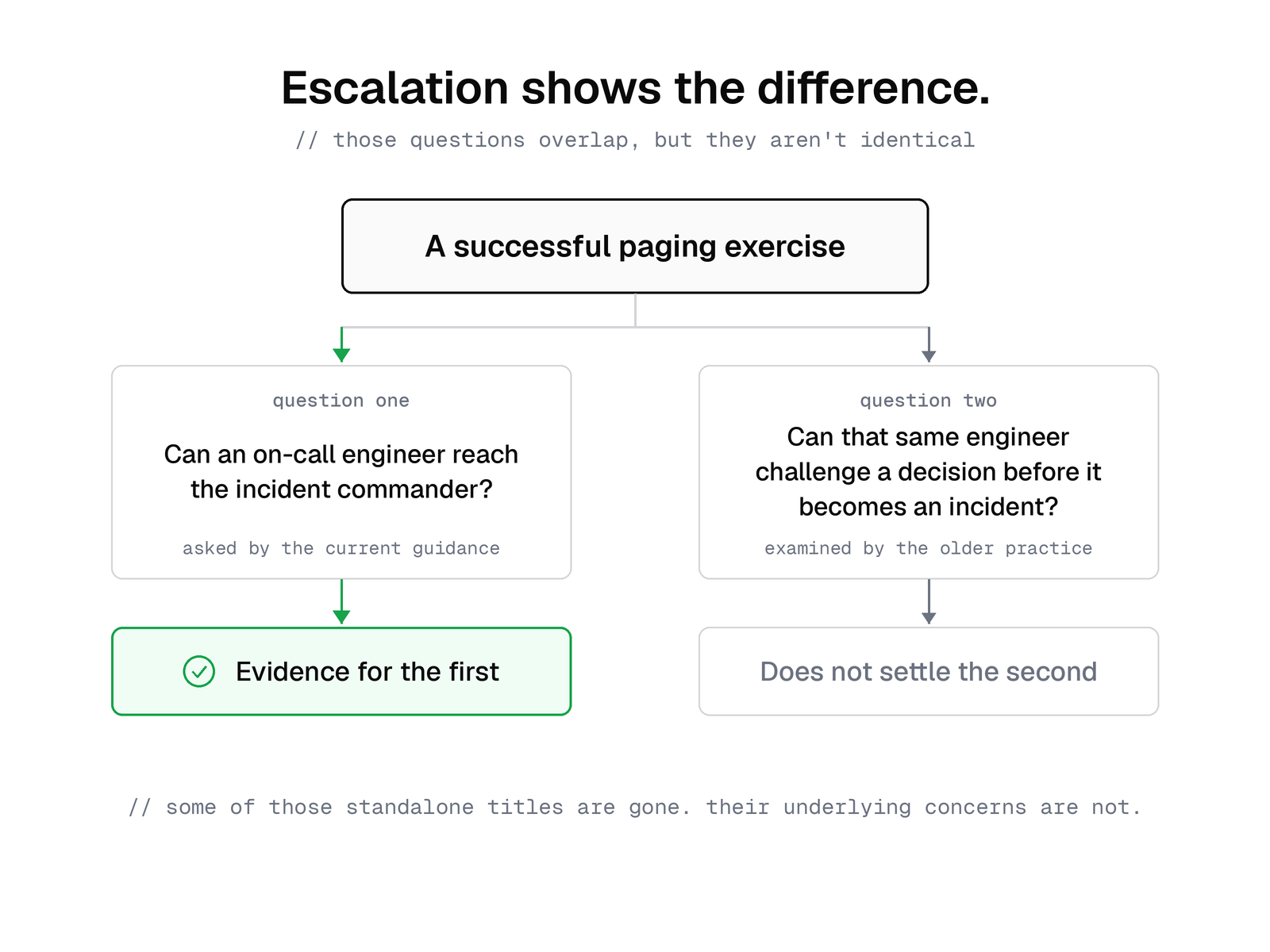
image description
One successful paging exercise feeds two questions. Can an on-call engineer reach the incident commander? The exercise is evidence for that. Can that same engineer challenge a decision before it becomes an incident? The exercise does not settle that.
The engineer who recommended the rollback is why I care about the difference. The escalation route already existed; she still had to exercise judgment under pressure and raise the concern while there was a choice.
An owner needs the authority to act
The revised framework doesn't reduce ownership to a tag. FND01-BP02 addresses ownership for billing, security, and operations, including the distinction between responsibility and authority. AWS explicitly warns about stale assignments and owners who cannot act. That's the right standard.
A shallow implementation, however, might stop after confirming that a resource has an owner field. A stronger review would ask whether the named team acknowledges the responsibility, has the permissions to respond, and knows when to involve someone else.
An agent can help gather that evidence. It can inspect assignments, approvals, incident timelines, and exercise results when those records are accessible. People aren't uniquely capable of reading history, and a meeting isn't automatically more truthful than a machine-generated report.
But evidence still requires interpretation. An approval record might show that a named owner signed off on a change. It can't, by itself, establish that the owner had the authority to say no. A human reviewer can't establish that with one checkbox either.
The boundary that matters is between evidence and conclusion, followed by authority and accountability for the decision.
This is the argument I made in Nobody Pages the Agent and Trust the Gate, Not the Actor. Agents can propose, inspect, and test. We still need explicit decision rights and people accountable for consequential outcomes.
A workload result depends on its foundation
The new Foundations and Workloads split may be the most important architectural improvement in the update.
I have spent much of my career in cloud working on shared platform capabilities. A good platform gives application teams dependable defaults for identity, networking, observability, and operational controls. The team building an application shouldn't have to reinvent those decisions every time.
That was part of the argument in Building Cloud From Zero. Platforms work when teams inherit reliable defaults instead of repeatedly negotiating them.
The new structure recognizes that division of responsibility. But it creates a question that every workload review should answer: which foundation review does this result depend on?
A workload might have strong application controls while relying on an account structure, identity boundary, or logging service that has not been reviewed recently. The workload review is still useful, and its conclusion has dependencies.
I would want a workload report to identify its applicable foundation review, when it was last evaluated, who owns unresolved risks, and which exceptions affect the workload. The responsibility may be shared across platform, security, network, finance, and application teams. It shouldn't disappear because those teams maintain different parts of the system.
The goal is to make inherited assurance traceable without asking every application team to review the entire landing zone.
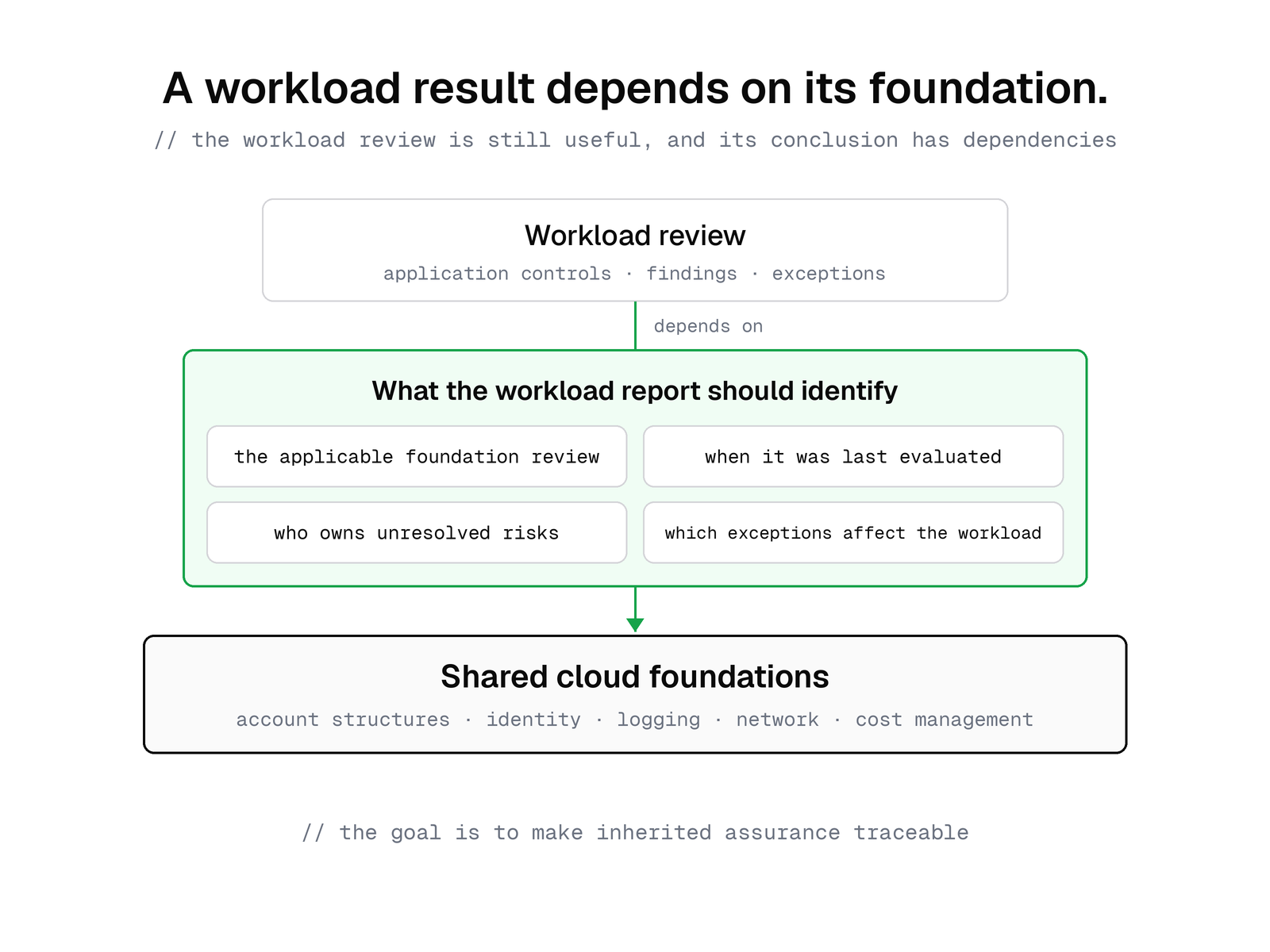
image description
A workload review sits above shared cloud foundations. A one-way link between them lists what the workload report should identify: the applicable foundation review, when it was last evaluated, who owns unresolved risks, and which exceptions affect the workload.
Keep the evidence with the review
I wouldn't respond to this update by restoring every retired question as another annual questionnaire. That would miss the opportunity automation creates.
Let agents collect the evidence they can reliably collect. Use that time to examine the decisions and behaviors that need context. Five questions belong in the conversation:
- Who owns this workload, and do they know it? Look for acknowledged responsibility, current coverage, and clarity about risk, change, and response authority.
- Who can stop a release? Look for explicit decision rights and an example or exercise showing how they work.
- What tradeoff did we accept? Look for alternatives, consequences, a named decision-maker, and conditions that would cause the team to revisit the choice.
- What happened after the last escalation? Look for the concern, the response, the decision, and what changed afterward.
- Which foundation review does this result depend on? Look for its date, its open risks, and the exceptions that touch this workload.
Don't stop at asking. Keep the answers with the review, alongside its framework or lens version, scope, supporting evidence, foundation dependencies, and unresolved questions.
A useful report distinguishes four outcomes: the evidence supports a requirement; the evidence shows it is unmet; the evidence is incomplete; or an accountable person has accepted a documented exception. Missing evidence should remain visible rather than quietly turning into a favorable result. OPS05-BP04 already treats a generated answer as a draft. Until a person rules on it, the checklist item stays open.
These records aren't substitutes for leadership. People still need opportunities to describe what the records miss, especially when the concern is whether speaking up feels safe. But a durable decision record gives the next reviewer, the next team, and the next agent something better than institutional memory.
AWS made a sensible move by reorganizing Well-Architected around what can be assessed more consistently. The leadership obligation is to make the limits of that assessment as visible as its findings. The review should tell us what we know, what we inherited, what we have not verified, and who can act on the difference.
Related reading
- What the Rollup Leaves Out
- Architecture Is What Agents Can't Refactor
- Nobody Pages the Agent
- Trust the Gate, Not the Actor
- Building Cloud From Zero
Sources
- AWS Architecture Blog: Announcing updates to the AWS Well-Architected Framework (November 16, 2026)
- Current AWS Well-Architected Framework
- Cloud Foundations
- Cloud Workloads
- FND01-BP02: Establish ownership for billing, security, and operations
- OPS05-BP04: Assess operational readiness
- OPS06-BP03: Define escalation paths
- SEC11: Application security
- COST01-BP02: Implement goals and targets
- PERF01-BP02: Evaluate the trade-offs between performance and other non-functional requirements
- February 2025: Organization
- February 2025: Escalation is encouraged