In my head, I have a tidy model for how my time should work.
Thirty percent for people. Thirty percent for the work in flight. Thirty percent for the future. Ten percent for the administrative machinery that keeps the lights on.
It's a clean model. It also falls apart almost every week.
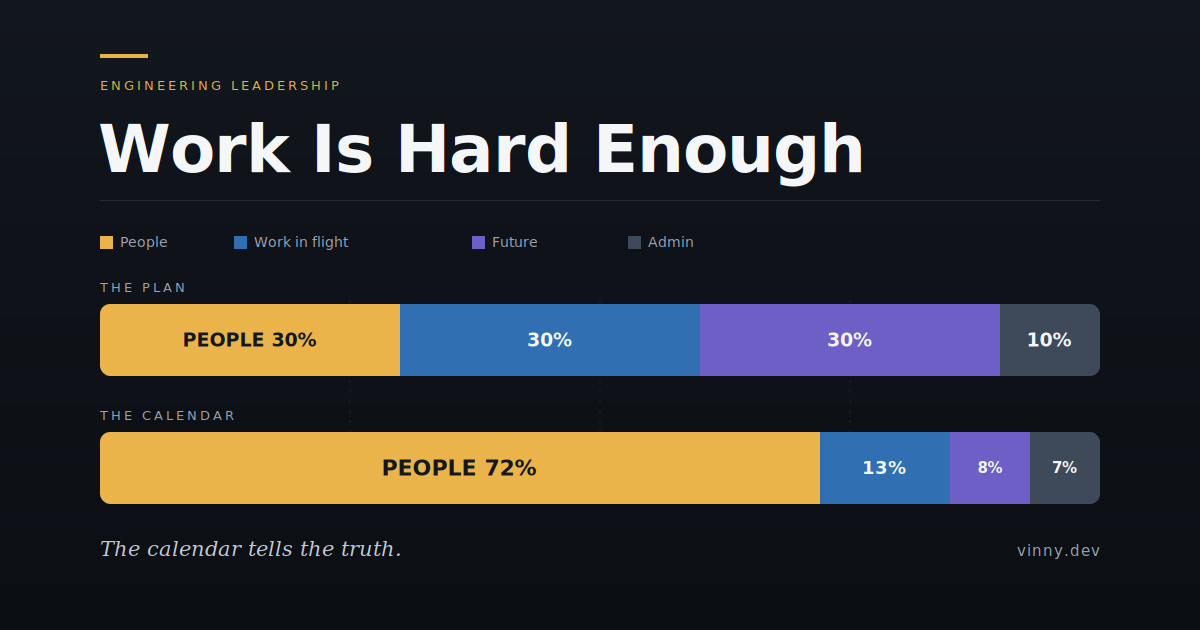
The people part runs past 70 percent more often than I expected. The strategy time gets squeezed. The operational work expands because operational work is apparently filled with gas and will occupy whatever container you give it. The administrative work never disappears, because calendars and approvals have not yet developed empathy.
For a while, I treated that as a problem with my discipline. I thought I needed to protect the model better, manage my calendar harder, or be more ruthless about where my time went. I now think the model was trying to teach me something about what the work is.
People are how the work gets done, and I deliver value through my teams rather than around them. That belief sits underneath everything else I do as a leader.
Work is hard enough on its own. We don't need to make it harder by mistreating each other, hiding the truth, making decisions unclear, or forcing people to spend their energy navigating avoidable human friction.
The leader's job is not to make hard work feel easy. Most meaningful work is hard for a reason. The leader's job is to remove the extra tax, the avoidable drag that has nothing to do with the difficulty of the work itself. That's the part we can do something about.
Kindness is not a vibe
I try to lead with humanity, humility, and empathy, and I want kindness and respect to be the defaults rather than the exceptions. But I don't mean kindness as a mood, politeness as a substitute for courage, or avoiding conflict because the conversation might get uncomfortable. That version of kindness is delay.
The kind of kindness I care about is operational. It shows up in how we run design reviews, how we make decisions, how we give feedback, how we handle disagreement, and how we talk about problems when the work gets tense. Kindness is one of the conditions that allows rigor to work.
A team that cannot disagree safely will eventually disagree quietly. Quiet disagreement is where bad decisions go to compound. People nod in the room, hedge in the hallway, and then spend the next six months proving through passive resistance that the decision never really landed. That's expensive, and it's completely avoidable.
The kindest thing a leader can do is make reality easier to tell the truth about. That means building a room where people can say, "I think this design is too complicated," or "We are underestimating the migration risk," or "I do not think this plan will survive contact with the teams who have to implement it," without paying a personal tax for saying it.
It also means making sure truth doesn't become theater. The point of creating safety is to make the real tradeoffs visible so the team can make a better decision and move.
Argue clearly, decide once, move together
People sometimes hear "kindness" and picture a team that tiptoes around hard conversations. That is not what I mean.
The best teams I have been part of argue constantly. They challenge assumptions, poke holes in designs, pressure-test tradeoffs, and push back with conviction. They are honest with each other, and they are sturdy enough to stay that way. The line I care about is simple: pressure belongs on the problem, not the person.
A heated design review can be healthy. Two engineers questioning each other's tradeoffs in front of the whole team can be exactly how the team gets sharper. A product leader challenging scope can protect the organization from fantasy planning. An operations leader forcing the group to look at reliability can keep everyone from mistaking optimism for readiness. That's all productive conflict.
But the moment the conversation shifts from the work to someone's worth, we've lost the plot. The debate stops improving the decision and starts damaging the system that has to carry the decision forward. So I try to protect the issue and the people at the same time.
You can take apart an idea and still treat the person who offered it with complete respect. You can disagree strongly, leave the room with trust intact, and make a hard call without making someone feel small for having argued the other side. Holding those things together is the job.
I've always appreciated the idea behind "disagree and commit," because it solves a real leadership problem. Debate cannot run forever. At some point, someone has to make the call, and not everyone will love it. But the phrase only works when both halves are real.
If people are expected to commit but were never allowed to meaningfully disagree, that is compliance wearing a nicer jacket. If they are allowed to disagree forever but never expected to commit, nothing is ever really decided and the work drifts.
The norm I care about is this:
Argue clearly. Decide once. Move together.
Argue clearly means we owe each other honest thinking. We don't hide behind vague concerns, passive language, or hallway commentary. We put the real issue on the table.
Decide once means the decision becomes clear enough that people know what changed, why it changed, who owns it, and what tradeoff we accepted.
Move together means that once the decision is made, we stop relitigating it through side channels. We may still inspect and adapt as reality teaches us more, but we don't quietly undermine the work because our preferred option lost. That is how trust becomes execution.
People are the work
The older I get as a leader, the more convinced I am that people work is the load-bearing part of leadership rather than a softer category of it.
I don't ship most of the work myself anymore. I don't personally build the platform, write the migration plan, debug every pipeline, secure every environment, or make every technical tradeoff. My value comes from helping the people who do that work move with more clarity, confidence, and trust.
That can sound abstract until you look at where the leverage lives. A one-on-one can prevent a strong engineer from burning out quietly, and a hard coaching conversation can turn a frustrating pattern into a growth moment. A clear decision can save three teams from spending two weeks optimizing for different versions of reality. A well-run debate can surface a risk early enough that it is still cheap to fix. A leader who makes expectations explicit can remove the low-grade anxiety that makes people guess instead of execute.
None of that is "extra." It is how strategy becomes real.
There is one more part of this that I hold tightly. I push the credit toward the team that did the work and keep the blame for myself, because the wins belong to them and the losses belong to me. That is less about humility than about making it safe for people to take real ownership, since they know a good-faith miss won't be hung around their neck.
It's easy to say people are your most important asset. That phrase shows up in nearly every company values deck ever written, usually somewhere between a stock photo of smiling coworkers and a sentence about excellence. Saying it costs nothing. Living it shows up in the calendar.
That's where my tidy model keeps losing. Thirty percent for people sounds reasonable until someone is navigating a hard transition, or a team is stuck between competing priorities, or a leader needs coaching through a decision they've never had to make before. Thirty percent sounds reasonable until you realize that the conversation you almost skipped was the one that opened up the next month of progress. So the people time grows, and honestly, I've made peace with that.
The trap is real
There is a trap here, though, and I don't want to pretend otherwise. "People are the work" can become an excuse to live entirely in the urgent and emotionally available part of leadership. A full calendar of one-on-ones can feel virtuous while the future goes unattended. Being available can become a substitute for being clear, and helping can become a way to avoid the harder work of setting direction.
That is not the goal. The answer is to make people time carry more of the strategy rather than to spend less of it.
Every coaching conversation should connect to the system we're trying to build, and every one-on-one should build ownership instead of dependency. A debate should leave the decision clearer instead of giving everyone room to perform their position. An escalation should teach us something about where the operating model is unclear. A recurring friction point should make us ask whether we are relying too much on heroic effort and not enough on durable defaults. That is the bridge I keep coming back to in my own thinking.
Leadership does not scale through willpower, and neither do culture, quality, or trust. If the system requires everyone to be perfectly brave, perfectly patient, perfectly aligned, and perfectly informed every day, the system is poorly designed. People are capable of extraordinary things, but "everyone must be extraordinary all the time" is a wish.
The work of leadership is to build the defaults, rituals, and norms that make the right behaviors easier to repeat. That's true in engineering systems, and it's true in human systems.
Trust is infrastructure
I've been writing a lot lately about the idea that the bottleneck in modern software development is shifting. As tools get faster and AI makes more of the mechanical work cheaper, the constraint moves to clarity. That means clarity of intent, of ownership, of tradeoffs, of what good looks like, and of what we will not do. But clarity doesn't survive in a low-trust system.
If people don't trust the room, they sand down the truth. If they don't trust leadership, they wait to be told. If they don't trust each other, they protect their own area and call it accountability, and if they don't trust the decision process, they keep lobbying after the decision is supposedly made. That's why I think trust is infrastructure and part of the delivery system.
A high-trust team can move faster because less energy leaks out through interpretation, self-protection, and politics. People can say the hard thing sooner, disagree without creating permanent damage, and commit without needing every decision to go their way. They can recover from mistakes without turning every miss into a courtroom drama.
A low-trust team pays a tax on everything. Every decision needs more explanation, every disagreement carries more risk, and every mistake creates more theater. Every handoff gets heavier because nobody is fully sure what will happen on the other side. That is drag.
And while some complexity is inevitable, drag is optional.
The calendar tells the truth
I still like my 30/30/30/10 model. It reminds me that I owe the organization more than availability. I owe it direction, operating clarity, and attention to the future as well as responsiveness to the present. I also owe it the discipline to avoid becoming the friendly bottleneck who helps everyone and scales nothing. But the model also reminds me that people are where leadership becomes tangible.
The calendar tells the truth. Not perfectly, but honestly enough.
If I say people matter but never make time for them, they will believe the calendar. If I say debate matters but punish dissent, they will believe the room, and if I say ownership matters but make every decision myself, they will believe the operating model. If I say kindness matters but tolerate disrespect from high performers, they will believe the exception. People listen to what leaders say, but they organize around what leaders permit, reward, and repeat.
That is why the small moments matter more than we like to admit: the tone in a hard meeting, the private coaching conversation instead of the public correction, and the willingness to clarify a decision that felt obvious only to the people in the room. None of those moments look very strategic on a calendar. They are.
A while back I tried to make all of this explicit. I wrote a user guide for working with me, a plain statement of how I make decisions, how to disagree with me, how to earn my trust, and what I owe you in return. Writing it down was the point, because beliefs are easy to claim in an essay and a team will hold you to the version you put in writing.
Work is hard enough
The work will stay hard. The systems are complex, the tradeoffs are real, and the decisions rarely arrive with clean edges. Teams will still disagree, priorities will still collide, and good people will still get tired. Plans will still meet reality and discover reality had edits.
Leadership does not remove that difficulty, but it can remove the extra tax: the personal friction, the unsafe disagreement, the unclear decision, the hidden assumption, the fear of speaking plainly, and the culture that makes people choose between being honest and being safe. That's why the people time keeps winning on my calendar. Strategy matters, and people are how it becomes real.
Work is hard enough. The least we can do is build teams where the hard part is the work itself.